-series
Definition
The -series is defined as the infinite series for any real number
Interpretation
The -series are the reference series for terms that decay like a power of . For the terms tend to , and measures how fast; the series converges if and only if , so the harmonic series, with , sits exactly on the boundary.
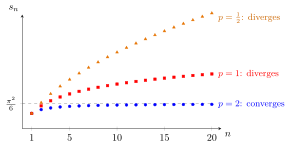
For (blue) the partial sums level off below the dashed line at ; after terms they are about . For (red) and (orange) the partial sums have reached about and and keep growing. The red sums grow only like , so slowly that the picture alone cannot show divergence; that needs a proof, by grouping terms or by the integral test.
Lower towards : the limit grows and the partial sums take longer to reach it. At they keep growing, even though slowly.
The summands come from the power function at positive integers. For , the integral test compares them with an improper integral; its -test gives convergence for . For , the terms do not tend to zero, so the series diverges.
The -series are the usual benchmarks for the comparison test for series: a series whose terms behave like for large converges exactly when . A common slip is to confuse them with the geometric series. In the exponent is fixed and the base varies, while in the base is fixed: converges, but diverges.
Key Results
- The series converges if and only if
- The series diverges for
- The convergence behaviour depends entirely on the exponent.
Examples
- converges.
- diverges.
- diverges.
Prerequisites
Related Concepts
Sources
- Math I: Calculus · Lecture 12
Aliases: p series, p-series, hyperharmonic series Symbols: infinity, pi, square root, sum
Last updated: 20 October 2026 03:02
p-seriesInfinite SeriesMonomial and Power FunctionIntegral Test for Convergencep-testHarmonic SeriesComparison Test for SeriesComparison Test for Improper Integrals