Subsequence
Definition
Where this appears in the course
Subsequences are not defined in the 2026-27 lectures. The definition is given inside the tutorial question that uses it (Tutorial 2), and this page records it in the same form.
Let be a sequence. A subsequence of is a new sequence obtained by selecting terms of along a strictly increasing sequence of indices with :
where
Interpretation
A subsequence is what you get when you thin out a sequence while keeping the original order. You choose infinitely many of its terms, further and further along, and you may not reorder or repeat them.
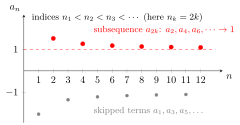
The figure keeps the even-indexed terms of , so and . These terms, , , , decrease to , while the skipped odd-indexed terms tend to .
Choose the indices : the even and odd subsequences of converge to different limits, which is why the whole sequence diverges.
The condition makes a subsequence a sequence in its own right. Because the indices are integers that strictly increase, when the sequence starts at , so the subsequence runs through the tail of as grows. This is why every subsequence of a sequence with limit also has limit . Lists such as or are not subsequences.
Subsequences are the usual tool for proving divergence: two subsequences with different limits, as in the figure, show that has no limit. They also return in Math III, where the Bolzano-Weierstrass theorem states that every bounded sequence has a convergent subsequence.
A common slip is to run the implication backwards. One convergent subsequence says nothing about the whole sequence: has the constant subsequence but diverges.
Key Results
- Every subsequence of a sequence uses terms from the original sequence, but with a new index set
- If then every subsequence also converges to
- Subsequence limits help detect non-convergence: if two subsequences converge to different limits, then the original sequence does not converge.
Examples
- If then and are subsequences.
- If then is a subsequence, and it still converges to
Prerequisites
Related Concepts
Sources
- Math I: Calculus · Tutorial 2
Last updated: 20 October 2026 03:02
SubsequenceSequentially Compact SetMonotone SequenceLimit of a SequenceCauchy SequenceBolzano Weierstrass TheoremSequence