Intersection of Sets
Definition
The intersection of two sets and is defined to be the set
Thus, consists of all the elements which belong to both and
Interpretation
The intersection of sets captures the elements common to all sets involved. An element of must pass both membership tests at once, so intersection is the set version of the logical "and".
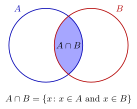
The shaded lens is where the two discs overlap; its points lie in and in . Points in only one of the discs are left out. The lens lies inside each disc, so and ; if the discs were moved apart, the lens would vanish and the sets would be disjoint.
The form reads as a filter: start from and keep the elements that also lie in . Although this notation treats and differently, the result does not depend on the order. If , the filter removes nothing: if and only if . By associativity, needs no brackets.
In probability, returns as the event that both and happen (see union and intersection of events).
Key Results
- An element belongs to the intersection if and only if it belongs to each set.
- Intersection is commutative (i.e., ) and associative (i.e., ).
- The intersection with the empty set is empty.
Examples
Prerequisites
Related Concepts
Sources
- Math I: Calculus · Lecture 1
Aliases: set intersection Symbols: element of, intersection, subset
Last updated: 22 October 2026 19:04
Intersection of SetsDisjoint SetsConditional ProbabilityDisjoint EventsUnion and Intersection of EventsExterior of a SetTopology and Topological SpaceSetUnion of SetsDifference SetComplementEmpty SetEvent