Injective Function
Definition
A function is injective if different elements map to different elements, i.e., for any
Interpretation
An injective function never merges inputs: different inputs always give different outputs. Equivalently, each output comes from at most one input, so the value is enough to recover .
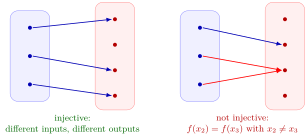
In the left diagram the three inputs go to three different points of , so the function is injective; one point of is not reached at all, which injectivity allows. In the right diagram the inputs share an output, , and this single collision is enough to make the function not injective.
In proofs the definition is mostly used in its contrapositive form: is injective if and only if, for all ,
So to prove injectivity, assume two outputs are equal and show that the inputs are equal; to disprove it, one pair suffices, as shows for on . For a function on a subset of , injectivity means that every horizontal line meets the graph at most once.
Injectivity depends on the domain: is not injective on , but it is injective on , and there its inverse is . Every strictly monotone function is injective, which gives a quick sufficient test. Together with surjectivity, injectivity makes a bijection with an inverse.
A common slip is to check the wrong implication. The statement holds for every function and says nothing about injectivity.
Key Results
- Injectivity depends on both formula and domain.
Examples
- is injective on
- is not injective on
Prerequisites
Related Concepts
Sources
- Math I: Calculus · Lecture 4
Aliases: one-to-one function, injection, injective Symbols: element of, infinity, real numbers, square root
Last updated: 20 October 2026 03:02
Injective FunctionBijection and Inverse FunctionLocal Injectivity, Surjectivity, and BijectivityDomainSurjective FunctionMonotone Function