Irrational Number
Definition
An irrational number is a real number but not a rational number, i.e., it is an element of the set
Interpretation
An irrational number cannot be expressed as a fraction of two integers. Such numbers arise from ordinary geometry, and they are what the real numbers add to the rationals.
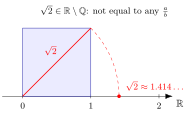
The diagonal of the unit square has length , since . Rotating it down onto the number line marks the point : a length that is easy to construct lands at a point that no fraction reaches. The classical proof is by contradiction. If in lowest terms, then , so is even; writing gives , so is even as well, which contradicts lowest terms.
A common slip is to expect the irrationals to be closed under arithmetic. They are not: and are rational. A rational number plus an irrational number, on the other hand, is always irrational.
Key Results
- A real number is rational exactly when it has a decimal expansion that terminates or is eventually periodic. Irrational numbers therefore have non-terminating decimal expansions that are not eventually periodic.
- Every real number is either rational or irrational, and never both.
Examples
- is an irrational number.
- and are irrational numbers.
- It is still unknown if is irrational or not.
Prerequisites
Related Concepts
Sources
- Math I: Calculus · Lecture 2
Symbols: pi, rational numbers, real numbers, square root
Last updated: 20 October 2026 03:02
Irrational NumberDirichlet FunctionRational NumberReal NumberDivision and QuotientEuler's Number