Poisson Splitting
Theorem
Let , and give each of the items a label, independently of each other and of : type 1 with probability and type 2 with probability . Then the numbers of type-1 and type-2 items are independent, with distributions and .
This is the Chicken–Egg Theorem applied to independently assigned labels: conditional on , the type-1 count is binomial, and averaging over the Poisson total gives the two independent Poisson counts.
Interpretation
Independent labels divide a Poisson count into independent Poisson category counts. Each category receives the share of the mean that matches its label probability, for type 1 and for type 2.
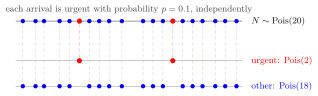
In the figure, arrivals are each marked urgent with probability , independently. The urgent arrivals form a count and the others a count; in this sample there are urgent and other arrivals. By independence, knowing how many urgent arrivals occurred says nothing about the number of other arrivals.
Each item is type 1 with probability . The two counts are independent, with distributions and ; press New sample to see them vary.
This is the chicken–egg theorem phrased in terms of labels, and both of its conditions matter. The labels must be independent of each other and of . The total must also be Poisson: for a fixed total , the type-1 count is and the type-2 count is minus it, so the two are dependent, and with a random total of another distribution they are in general dependent as well.
A common misreading is that the type-1 count is binomial and therefore tied to the type-2 count. It is binomial only conditionally on ; averaged over the Poisson total it is and independent of the other count. Splitting reverses Poisson merging, which adds the two counts back into . For a fixed number of items, the counts of several label types follow the multinomial distribution instead, and they are dependent.
Key Results
- The two parameters add to the original parameter: .
- For independent categorical labels with probabilities , the category counts are independent variables.
Examples
- A Poisson arrival count of mean , labelled urgent with probability , yields independent counts of means and .
- For mean and label probabilities , the three counts are independent Poisson variables of means .
Prerequisites
Related Concepts
Sources
- Nicky van Foreest · Probability Distributions · Week 1
Aliases: Poisson thinning Symbols: lambda
Last updated: 20 October 2026 03:02
Poisson SplittingChicken–Egg TheoremMultinomial DistributionPoisson ProcessPoisson DistributionPoisson Merging