Conditional Expectation and Independence
Proposition
Let . If and are independent (), then almost surely.
Interpretation
If the response is independent of the observed variable , observing cannot change the expected value of : the best prediction of given is the constant .
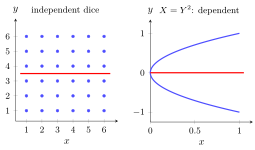
The red lines show . For independent fair dice this equals in every column. A constant conditional mean does not imply independence: if and , then given the values are equally likely, so almost surely, yet and are dependent.
Under independence the conditional distribution of given is the unconditional distribution of , for every , so its mean is . This gives more than the mean: for every integrable . The words almost surely are needed because is only determined up to events of probability zero.
The proposition is the first step of a chain: independence implies a constant conditional mean, which implies zero covariance when the variances are finite. The second step uses taking out what is known and Adam’s law: . Neither step can be reversed. The figure shows the first; for the second, and are uncorrelated, but is not constant.
Note the direction: the proposition is about . In the right panel is constant, but is not, which already shows the dependence.
Key Results
- Independence gives for every integrable .
- The converse fails: a constant conditional mean does not by itself imply independence.
Examples
- For independent fair dice , .
- For and , symmetry gives , yet and are dependent.
Prerequisites
Related Concepts
Sources
- Nicky van Foreest · Probability Distributions · Week 4
Symbols: infinity, square root
Last updated: 20 October 2026 03:02
Conditional Expectation and IndependenceConditional Expectation Given a Random VariableIndependent Random VariablesCorrelation