Weak Law of Large Numbers
Theorem
Let be independent and identically distributed, with and mean . Then their sample mean satisfies
Probability Distributions uses the sufficient finite-variance case , which admits the explicit Chebyshev proof below. Finite variance is not required for the more general integrable i.i.d. statement.
The conclusion is Convergence in Probability, so it asks whether each fixed-tolerance error probability tends to zero. In the finite-variance case, Chebyshev Inequality bounds that probability by , which does tend to zero.
Interpretation
For a large i.i.d. sample with a finite mean, the sample mean is close to the population mean with high probability: for every fixed tolerance , . Finite variance additionally supplies a quantitative bound through the Chebyshev inequality.
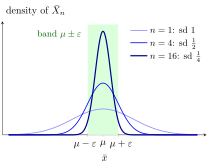
The figure shows the distribution of for , and with . Since , the standard deviation halves each time is multiplied by four: , , . The probability outside the band therefore shrinks, and by Chebyshev it is at most .
For a fixed , (right) falls to as grows, always below the Chebyshev bound used in the proof.
The finite-variance proof uses two facts: by linearity of expectation, and , because variances of independent terms add. Independence matters: if every equals , then and its spread never shrinks. The bound also shows how the sample size must grow when the tolerance shrinks: halving requires four times as many observations for the same bound.
A common misreading is that the sum gets close to . It does not: has standard deviation , which grows. Only the average is pinned down. The central limit theorem describes the size and shape of the remaining error on the scale , and the strong law strengthens the conclusion to almost-sure convergence.
Key Results
- .
- Chebyshev gives for each .
Examples
- For i.i.d. variables, the proportion of successes converges in probability to .
- For i.i.d. variables and , the probability that the sample mean differs from by at least is at most .
Prerequisites
- Sample Mean
- Convergence in Probability
- Independent and Identically Distributed Random Variables
- Chebyshev Inequality
- Variance and Standard Deviation
Related Concepts
Sources
- Nicky van Foreest · Probability Distributions · Week 7
Aliases: WLLN, weak law Symbols: epsilon, infinity, mu, sigma, square root, sum
Last updated: 20 October 2026 03:02
Weak Law of Large NumbersSample MeanConvergence in ProbabilityIndependent and Identically Distributed Random VariablesChebyshev InequalityVariance and Standard DeviationStrong Law of Large NumbersCentral Limit Theorem