Norm and Normed Vector Space
Definition
A norm on a vector space over the scalar field or (in this course ) is a function that adheres to the following criteria:
- Nonnegativity and definiteness: For any , , and if and only if .
- Absolute homogeneity (absolute scalability): For any scalar and any , , where is the absolute value (modulus) of .
- Triangle inequality: For any : .
A normed vector space is a vector space over or , equipped with a norm .
The norm version of the Triangle Inequality bounds the length of a sum by the sum of the lengths. The Euclidean Norm is the standard example satisfying all three axioms.
Interpretation
A norm is a rule that assigns a length to every vector in a way that fits the vector-space operations. A normed vector space is a vector space in which every vector has such a length, and scaling or adding vectors changes lengths as one would expect.
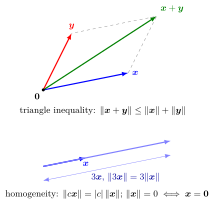
The upper part of the figure shows the triangle inequality: is the diagonal of the parallelogram spanned by and , and its length is at most . The lower part shows absolute homogeneity: stretching by the factor multiplies its length by .
Each gives a norm on with its own unit circle; all of them are convex and symmetric about .
Absolute homogeneity also covers negative scalars, so : a vector and its opposite have the same length. Together the three axioms make a metric, and a metric of this form has two properties that a general metric lacks: it does not change under translation, , and it scales, . The discrete metric does not scale, since for , so it comes from no norm.
The Euclidean norm from Math II is one norm among many. The -norms, including the taxicab norm and the maximum norm, are others on , and the uniform norm measures bounded functions.
Norms return in Math V, where the largest singular value of a matrix serves as a length for matrices.
Key Results
- Given a normed vector space , one can define the metric as making inherently a metric space.
Examples
- The real line with the absolute-value norm forms a normed vector space over .
- The plane with the Euclidean norm is similarly a normed vector space. Using the taxicab norm, remains a normed vector space.
Prerequisites
Related Concepts
Sources
- Math III: Analysis · Lecture 4
Aliases: normed space, normed vector space Keywords: norm Symbols: complex numbers, element of, infinity, real numbers, square root
Last updated: 20 October 2026 03:02
Norm and Normed Vector SpaceComplete Metric SpaceEquivalent NormsMaximum NormTaxicab MetricVector SpaceTriangle InequalityEuclidean Normp-norm and p-metricMetric and Metric Space