Equivalent Norms
Definition
Two norms and on a vector space (the subscripts are just labels for two arbitrary norms, not necessarily -norms) are termed equivalent if there exist constants such that for every , we have:
For example, the Euclidean Norm and maximum norm on satisfy . These constants show precisely how their lengths are comparable.
Interpretation
Equivalent norms are different ways of measuring length that agree up to fixed scaling factors: a vector that is short in one norm is short in the other, and the constants and say by how much the two lengths can differ. Geometrically, the unit circle of one norm fits between two scaled copies of the unit circle of the other.
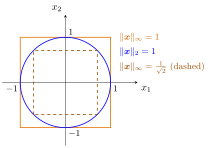
On , the illustrated norms satisfy , so they are equivalent. In the figure, the Euclidean unit circle lies inside the square , which is the left inequality, and outside the dashed square , which is the right inequality.
Pick and : the -circles of radius and squeeze the -unit circle between them, so .
The constants must not depend on . This uniformity is what makes equivalent norms interchangeable in analysis: the metrics they define are strongly equivalent, so they have the same convergent sequences and the same Cauchy sequences. On , where all norms are equivalent, the choice between the Euclidean, taxicab and maximum norm is a matter of convenience; the constants usually depend on , as in .
A common slip is to take equivalence of all norms for granted in every vector space. It is a finite-dimensional fact. For continuous functions on , the uniform norm and are both norms, but has uniform norm while the integral tends to , so no constant gives for all .
Key Results
- Any two norms and on a finite-dimensional vector space are equivalent.
Examples
- The Euclidean norm and the taxicab norm are equivalent.
Prerequisites
Related Concepts
Sources
- Math III: Analysis · Lecture 4
Aliases: norm equivalence Symbols: element of, infinity, integral, real numbers, square root
Last updated: 20 October 2026 03:02
Equivalent NormsNorm and Normed Vector SpaceEuclidean NormVector SpaceStrongly Equivalent MetricsTopologically Equivalent Metrics