Cover
Definition
Consider a (topological) space Let be a subset of and let be a collection of subsets of indexed by an arbitrary index set The collection is called a cover of if
- An open cover is a cover where each "patch" is open.
- A finite cover consists of a collection where is finite. A cover is called a countable cover when is a countable set, e.g.,
- A subcover is a cover that is a subset of another cover.
The Union of Sets collects all points lying in at least one patch ; the inclusion requires every point of to occur in that union.
Interpretation
A cover is just a collection of sets that together contain the set you care about. Think of it as laying patches over the set so that every point is under at least one patch; the patches may overlap and may stick out beyond the set.
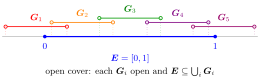
Five open intervals lie over , and every point of the segment is under at least one of them. The outer two reach beyond and , as they must: an open interval containing also contains points to the left of . Since each is open and there are finitely many, this is a finite open cover.
The index set only labels the patches and may be infinite. A subcover keeps some of the patches, but it must still cover : patches can be dropped only as long as no point of is left uncovered.
Covers matter because of compactness: a set is compact if every open cover has a finite subcover. The first Example shows how this fails for . The intervals increase with , so finitely many of them cover only the largest one, , and no finite subcover exists. For , by contrast, every open cover can be reduced to finitely many patches, as the Heine-Borel theorem guarantees.
A common slip is to read "every open cover has a finite subcover" as "some finite open cover exists". The second is always true, because the space itself covers , as the Key Results note.
Key Results
- Any set is covered by the space . So covers always exist.
Examples
- The set in can be covered by the collection of open sets . This is an infinite open cover.
- The set is covered by the three singletons , , . That is a finite cover.
- The set of rational numbers in can be covered by open intervals centred at each rational with radius . That's a countable cover because is countable.
Prerequisites
Related Concepts
Sources
- Math III: Analysis · Lecture 9
Symbols: element of, natural numbers, rational numbers, real numbers, subset
Last updated: 20 October 2026 03:02
CoverCompact SetConnected and Disconnected SetsUnion of SetsOpen and Closed Sets in a Metric SpaceCountable and Uncountable SetsHeine-Borel TheoremSequentially Compact Set