Polynomial on 
Definition
A polynomial on is a real-valued function that is a finite sum of monomials on . The degree of a polynomial on is defined as the maximum, over all its monomials with nonzero coefficient (after like terms have been combined), of the total degree of each monomial (the zero polynomial is usually left without a degree).
With one variable this reduces to an ordinary Polynomial; with several variables the same finite-sum construction uses multivariate monomials.
Interpretation
A polynomial in several variables is a finite sum of monomials. Its degree is the highest total degree among the monomials that appear with nonzero coefficient.
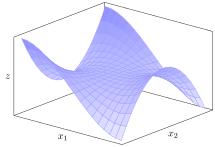
The plotted polynomial is the sum of two monomials, each of total degree . In polar coordinates , so around the origin the surface rises and falls three times. Along the -axis it is the cubic , which takes both signs near , so the surface has neither a peak nor a pit at the origin.
Drag the picture to turn it. has degree ; compare it with the degree- examples, whose graphs are bowls and saddles.
The degree counts total degree, not the largest single exponent: has degree , although no variable appears with a power above . In a sum, top-degree terms can cancel, so has degree ; this is why the Key Results give only an upper bound for the degree of a sum.
Low degrees give familiar functions. The polynomials of degree at most , together with the zero polynomial, are exactly the affine functions . A polynomial whose terms all have degree is a quadratic form. Grouping the terms by total degree writes every polynomial as a sum of homogeneous polynomials.
Key Results
- For nonzero polynomials and , the degree of is the sum of their degrees. If , its degree is at most the maximum of their degrees. Complete cancellation gives the zero polynomial, whose degree is left undefined here.
- Polynomials are infinitely differentiable. All partial derivatives of all orders exist and are themselves polynomials (or zero).
Examples
- is a polynomial of degree 2. Its highest total degree comes from , , and , all degree 2.
- has degree 3 from the term.
Prerequisites
Related Concepts
Sources
- Math III: Analysis · Lecture 7
Aliases: polynomial in more than one indeterminate, polynomial in more than one variable, multivariate polynomial, polynomial in several variables, multivariable polynomial Symbols: real numbers, theta
Last updated: 27 October 2026 11:52
Polynomial on R^nHomogeneous PolynomialMonomial on R^nPolynomialFieldRoot of a PolynomialVector SpaceLinear MapQuadratic Form