Power Series
Definition
Let A power series centred at is expressed as where is a sequence of real numbers, independent of We refer to as the -th coefficient of the power series.
Viewed as an Infinite Series of Functions, its th summand is . Convergence asks whether the partial sums of these functions have a limit at the chosen .
Interpretation
A power series is an infinite sum of power functions , a polynomial of unlimited degree centred at . For each fixed it is a numerical series that may or may not converge; the definition itself does not say for which it does.
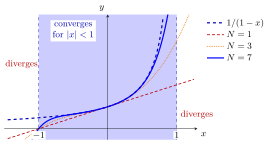
The figure takes and for all , the geometric series , and shows its partial sums with , and terms next to . On the shaded interval the partial sums approach ; outside it the terms do not tend to , and the partial sums move away. The function exists for as well, but the series does not represent it there.
Raise : inside the shaded interval of convergence the partial sums settle on the sum; outside they run away.
The centre and the coefficients determine the series. At every term with vanishes and the sum is ; here is read as even at . Away from the centre, convergence depends on the distance , which is measured by the radius of convergence. Within that radius the sum is a differentiable function that can be differentiated term by term, by the theorem on convergence of power series.
Power series are how many standard functions are defined or computed. The series in the Examples has sum , the exponential function. A function that equals a power series near each point of an open interval is real analytic; the series is then built from the derivatives of the function at the centre, which returns later as the Taylor series.
Key Results
- The definition is formal: it does not say for which the series converges. Every power series has a radius of convergence : it converges absolutely for and diverges for
Examples
- Any polynomial is a special case of a power series, since the coefficients are allowed to be zero.
- is a power series.
Prerequisites
Related Concepts
- Convergence of Power Series
- Real Analytic Function
- Taylor Series
- Polynomial
- Weierstrass Approximation Theorem
Sources
- Math III: Analysis · Lecture 2
Symbols: element of, infinity, real numbers, sum
Last updated: 20 October 2026 03:02
Power SeriesRadius and Interval of ConvergenceMonomial and Power FunctionInfinite Series of FunctionsConvergence of Power SeriesReal Analytic FunctionTaylor SeriesPolynomialWeierstrass Approximation Theorem