Topologically Equivalent Metrics
Definition
Two metrics and on a space are termed (topologically) equivalent if they produce identical topology (the set of open subsets of ) on , i.e., a subset is open with respect to if and only if it's open under . This relationship is expressed as
Interpretation
Two metrics are topologically equivalent if they determine the same collection of open sets. They may measure distances differently, but they agree on which sets are open, and therefore on every notion that is defined through open sets.
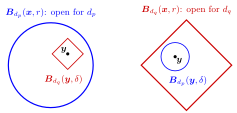
In the left panel, the round -ball is -open, and around its point fits a diamond-shaped -ball , so is an interior point of that ball for as well. The right panel does the same with the roles swapped. If this works around every point of every ball, a set is -open if and only if it is -open: the two metrics give the same topology.
The radius may depend on the point and on ; no fixed ratio between the metrics is required. This is the difference from strongly equivalent metrics: there gives with the same factor everywhere, which is why strong equivalence implies topological equivalence. On all -metrics are strongly equivalent, so "open" in does not depend on which of them is used.
Topologically equivalent metrics have the same convergent sequences. A common slip is to assume that they also agree on how large distances are. On , gives the same open sets as , although under it no two points are more than apart. Similarly, is a Cauchy sequence for on but not for from the Examples.
Key Results
- If two metrics are strongly equivalent, then they are topologically equivalent.
Examples
- On the interval the metric is topologically equivalent to the absolute value metric, but they are not strongly equivalent: the ratio is unbounded near
- The discrete metric is not topologically equivalent to any -metrics.
Prerequisites
Related Concepts
Sources
- Math III: Analysis · Lecture 6
Aliases: topologically equivalent Symbols: delta, pi, real numbers, subset
Last updated: 20 October 2026 03:02
Topologically Equivalent MetricsTopology and Topological SpaceOpen and Closed Sets in a Metric SpaceStrongly Equivalent MetricsEquivalent Norms