Open Metric Ball
Definition
For a metric space , a point in , and , the open metric ball in , centred at with radius in metric , is defined as the following set:
If the context is clear, we'll abbreviate this as or simply
A ball is a subset of selected by the distance condition; the ambient space matters, so a real-line ball and a plane ball have different members.
Interpretation
An open metric ball is the set of all points whose distance from the centre is strictly less than the radius . In with it is the open interval , and in the plane with the Euclidean distance it is an open disc.
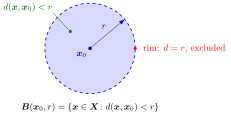
The green point satisfies and belongs to the ball. The red point on the dashed rim has exactly and is excluded, because the inequality in the definition is strict.
Change the centre, the radius and the metric: the ball contains the points at distance less than . Points on the dashed sphere are not included.
The strict inequality is what makes the ball an open set. If , put . By the triangle inequality, every with has , so : every point of the ball has a smaller ball around it that still fits inside.
"Ball" refers to the distance condition, not to a round shape. In the unit ball is a diamond for the taxicab metric and the open square for the distance of the maximum norm; here the centre is the origin.
Open balls are the basic building block of analysis in metric spaces: interior points and open sets are defined with them, and convergence means that every ball contains all but finitely many terms. On the real line, is the set familiar from the absolute value and the - definitions of Math I. Later, continuity between metric spaces is phrased with balls in the same way.
Key Results
- Open balls are open sets.
- A subset of a metric space is open if and only if it can be written as a union of open balls.
Examples
- In with the usual distance, is the open disc of radius centred at the origin. Points with are elements of this ball.
- In with the taxicab metric , is a diamond shape with vertices at and .
- In any set with the discrete metric, and , but is the whole space.
Prerequisites
Related Concepts
Sources
- Math III: Analysis · Lecture 5
Aliases: open ball, ε-neighbourhood, ε-ball Symbols: delta, element of, epsilon, real numbers, subset
Last updated: 20 October 2026 03:02
Open Metric BallAccumulation Point in a Metric SpaceAdherent Point and Closure of a SetBounded Set in a Metric SpaceContinuity between Metric SpacesExterior of a SetInterior of a SetLocal Maximum and Minimum on \(\mathbb{R}^n\)Metric and Metric SpaceSubsetBoundary of a SetOpen and Closed Sets in a Metric SpaceClosed Metric Ball