Jacobian Matrix
Definition
Suppose , and is an interior point of . For a function that each of its partial derivatives exists at , the following matrix
is called the derivative matrix or the Jacobian matrix.
Each row is the Gradient of one scalar component . When the function is totally differentiable, multiplying this matrix by an increment gives the Linear Map that approximates the output change; the existence of partial derivatives alone does not guarantee that approximation.
Interpretation
The Jacobian matrix stacks all the partial derivatives of a vector-valued function, showing how each output changes with each input: the entry in row and column is . When is totally differentiable, it is the matrix of the linear map that best approximates near .
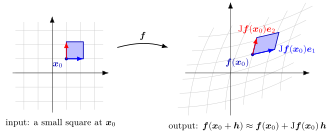
The small square at with sides along and is sent to the small parallelogram at spanned by and , the two columns of the matrix, in line with . The curved grid on the right shows that this is only a first-order picture.
Row is the transposed gradient of the component : how one output responds to all inputs. Column is : how all outputs respond to one input. The matrix is , outputs by inputs, so for it is the row vector , and for it is the matrix .
For a totally differentiable with , the absolute value of the determinant of the Jacobian is the factor by which scales small areas or volumes near , as does for the linear map . This factor appears in the transformation of densities of random vectors.
A common slip is to treat the Jacobian as the derivative whenever it exists. All partial derivatives can exist while is not totally differentiable, and then the approximation above can fail. In Math IV, Jacobians return in the multivariable chain rule, where the matrices of composed functions are multiplied.
Key Results
- The total derivative of a differentiable function is represented by the Jacobian matrix: the Jacobian is the matrix of this linear map with respect to the standard bases.
- The existence of the Jacobian matrix does not necessarily imply the total differentiability of the function.
Examples
- Let . Then , , so
Prerequisites
Related Concepts
Sources
- Math III: Analysis · Lecture 12
Aliases: Jacobian, derivative matrix, Jacobi matrix Symbols: nabla gradient, partial, real numbers, subset
Last updated: 20 October 2026 03:02
Jacobian MatrixBordered Hessian MatrixExogenous and Endogenous VariablesImplicit Function TheoremJacobian Rank Local Behaviour TheoremMultivariable Chain RuleMultivariate Taylor ApproximationsNondegenerate Constraint QualificationPartial JacobiansGradientMatrixLinear MapTotal Derivative as a Linear Map