Infinite Series of Functions
Definition
Consider a sequence of functions from to If the sequence of partial sums converges to pointwise or uniformly on as then we say the infinite series converges pointwise/uniformly to on denoted as
Interpretation
A series of functions is defined through its partial sums: each is an ordinary finite sum of functions, and the series converges to when the sequence does. Every question about a series of functions is therefore a question about the sequence of partial sums, and the results on pointwise and uniform convergence of sequences apply directly.
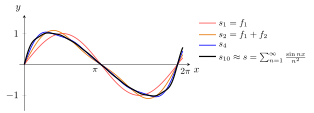
The figure shows the partial sums with , , and terms of on . Each new term changes the curve less, and the later sums are almost indistinguishable. Since for every , the sum with terms differs from the full sum by at most at every point at once; this is the bound used in the Weierstrass -test.
Raise : the partial sums settle on the limit function (dashed).
Pointwise convergence at is convergence of the numerical infinite series , so the tests for numerical series apply for each fixed . Uniform convergence asks more: the largest error must tend to . A finite sum can always be differentiated and integrated term by term; for an infinite sum, the Key Results need uniform convergence. Without it, a sum of continuous functions can be discontinuous: equals for and at .
Power series are the most important special case, and normal convergence is the usual way to show that a series converges uniformly.
A common slip is to differentiate term by term because the series itself converges uniformly. The condition is on the derivative series: converges uniformly, but its derivative series is the harmonic series at and diverges.
Key Results
- If 's are (continuously) differentiable, and on then is (continuously) differentiable on with i.e., for every ,
- On a finite closed interval with , if every is Riemann integrable and converges uniformly, then its sum is Riemann integrable and
The finite interval matters: the integral of a uniform error is at most times that error. Uniform convergence alone does not provide this bound for an improper integral on an unbounded interval.
Examples
- The series converges uniformly (by the Weierstrass -test) on every fixed interval , where : , and . It converges pointwise on , but not uniformly there; for each finite partial sum, the difference from is unbounded as .
- The geometric series converges uniformly on for every fixed , because and . On it converges pointwise to , but not uniformly: the remainder is unbounded as .
Prerequisites
Related Concepts
Sources
- Math III: Analysis · Lecture 2
Aliases: series of functions, function series Symbols: element of, infinity, integral, pi, real numbers, sum
Last updated: 20 October 2026 03:02
Infinite Series of FunctionsNormal ConvergencePower SeriesWeierstrass FunctionWeierstrass M-testInfinite SeriesPointwise ConvergenceUniform Convergence