Real Analytic Function
Definition
Let be a function where We say:
- is real analytic at if is an interior point of and there exists a power series centred at and an open interval (for some ) where this series converges to
- is real analytic on if is an open set and is real analytic at every point
The results on Convergence of Power Series justify differentiating the local representation term by term inside its radius. Analyticity requires the resulting series to equal , not merely to exist formally.
Interpretation
A function is real analytic at a point if near it equals the sum of a power series centred at : not only approximated by it, but equal to it on a whole open interval .
The point must be an interior point of so that such an interval fits inside the domain, and "real analytic on " is defined for an open set so that every point has room for its own interval. Once a series represents near , its coefficients are forced: by convergence of power series the series can be differentiated term by term, and evaluating the -th derivative at gives . So is real analytic at if and only if is infinitely differentiable near and the series converges to on some interval around .
One series need not serve the whole domain, which is why the definition asks for a series at every point. The function is real analytic on , yet its power series at , the geometric series , has radius and represents it only on ; around other centres, other series take over.
A common slip is to think that an infinitely differentiable function is automatically real analytic. The function in the Examples is infinitely differentiable, but all its derivatives at vanish, so the series built from them is the zero series: it converges, but to rather than to . The series built from the derivatives returns later as the Taylor series.
Key Results
- The power series converges to pointwise on and uniformly on every closed subinterval with .
- Sums, products, and compositions of real analytic functions are also real analytic.
- A real analytic function is always infinitely differentiable, and all of its higher-order derivatives are real analytic.
Examples
- Polynomials, , and are real analytic on , and is real analytic on .
- An infinitely differentiable function need not be real analytic. The function with for and for is infinitely differentiable on but not real analytic at .
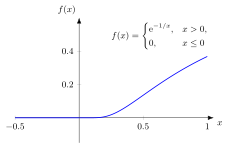
Every derivative of at is , so its Taylor series at is the zero series, yet for , so that series does not represent on any interval around .
A real analytic function equals its Taylor series near each point . Move : the interval of convergence moves and changes size with it.
Prerequisites
Related Concepts
Sources
- Math III: Analysis · Lecture 2
Aliases: analytic function Symbols: element of, infinity, real numbers, subset, sum
Last updated: 20 October 2026 03:02
Real Analytic FunctionTaylor SeriesOpen and Closed Sets in a Metric SpaceConvergence of Power SeriesDifferentiability ClassPower Series