Convergence in a Metric Space
Definition
Given a metric space , a sequence and a point in , the sequence is said to converge to under metric if .
Interpretation
A sequence converges to when its distance to tends to . This is just like convergent sequences of real numbers, but with a general notion of distance: the definition reduces convergence in any metric space to the convergence of the real numbers to .
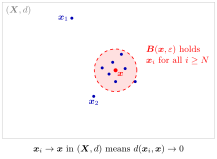
Written out, the definition says that for every there is an with for all . In the figure the terms spiral in towards ; the shaded disc of points within distance of misses some early terms such as and , but holds every term from some index on. A smaller may require a larger .
For each there is an after which every lies in the -ball around the limit. Change the metric: changes, the limit does not.
A limit, when it exists, is unique: if and , the triangle inequality gives , so . Whether a sequence converges depends on the metric. Under the discrete metric, forces , so only sequences that are eventually constant converge; converges to for but not for . Strongly equivalent metrics, such as the Euclidean and taxicab metrics in the Examples, have the same convergent sequences.
A common slip is to confuse converging with terms getting close to each other. The latter is the Cauchy property, and in a space with missing points, such as , a Cauchy sequence need not converge.
Key Results
- A convergent sequence in a metric space must be a Cauchy sequence.
Examples
- The sequence where in converges to under the Euclidean metric .
- The sequence where in also converges to under the taxicab metric .
Prerequisites
Related Concepts
- Strongly Equivalent Metrics
- Discrete Metric
- Cauchy Sequence in a Metric Space
- Accumulation Point in a Metric Space
Sources
- Math III: Analysis · Lecture 4
Symbols: epsilon, infinity, rational numbers, real numbers
Last updated: 20 October 2026 03:02
Convergence in a Metric SpaceComplete Metric SpaceDirectional DerivativeEquivalent Formulation of ContinuitySequentially Compact SetTotal Derivative as a Linear MapMetric and Metric SpaceLimit of a SequenceStrongly Equivalent MetricsDiscrete MetricCauchy Sequence in a Metric SpaceAccumulation Point in a Metric Space