Taylor Series
Proposition
Let be an interior point of and let be real analytic at Then, for some with , has the power series expansion around :
known as the Taylor series of around
Interpretation
If a function is so smooth that it behaves exactly like an infinite polynomial near a point, then that polynomial is built entirely from its derivatives at that point. The Taylor series makes this precise: for a real analytic , knowing determines on a whole interval around .
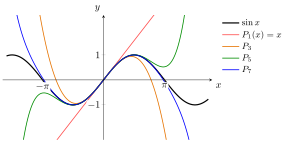
The figure shows the partial sums of the Taylor series of at ; only odd powers occur, because the even derivatives of vanish at . Each partial sum is a Taylor polynomial and follows over a wider interval than the previous one: stays within of on all of . Further out, every partial sum leaves the band , but for each fixed the partial sums converge to as the degree grows.
For and the Taylor polynomials converge to inside the shaded interval and not beyond it; for and everywhere.
Real analyticity is the hypothesis that makes the series equal . Being smooth is enough to write the series down, but not for it to converge to , as the smooth function in the Key Results shows. Even for an analytic function the equality is limited by the interval of convergence: is defined for all , but its Taylor series at converges only for .
Taylor series are how exponentials and trigonometric functions are handled as sums. The Poisson distribution has total probability because . The exponential series returns in Math V, where the same sum with a square matrix in place of the number defines the matrix exponential.
Key Results
- The Taylor series centred at the origin is called the Maclaurin series.
- For any smooth function you can write down its Taylor series around , but it need not converge to the function: it equals on a neighbourhood of if and only if is real analytic at For example, for , , is smooth, but its Taylor series at is identically
Examples
- The Taylor series of the natural exponential function at the origin:
- The generalized binomial expansion (binomial series) at the origin, which extends the binomial theorem to real exponents, valid for and any real exponent (and for all when is a nonnegative integer, since the series then terminates):
where
Prerequisites
Related Concepts
Sources
- Math III: Analysis · Lecture 3
Aliases: Taylor expansion Keywords: Maclaurin series, exponential series Symbols: alpha, element of, infinity, lambda, pi, real numbers, subset, sum
Last updated: 22 October 2026 19:04
Taylor SeriesMatrix ExponentialReal Analytic FunctionTaylor PolynomialConvergence of Power SeriesFactorialHigher-Order DerivativePower Series