Consider the seriesn=1∑∞an where an∈R and an=0 for all sufficiently large n. Let L=n→∞limanan+1 when this limit exists (possibly as +∞). Then:
If L<1, the series converges. Moreover, n=1∑∞∣an∣ also converges.
If L>1, the series diverges.
If L=1 or the limit does not exist, the test is inconclusive.
The ratio test compares a series with a geometric series. If consecutive terms eventually shrink by a factor close to L<1, the terms decay at least as fast as a geometric sequence with a ratio between L and 1, and the series converges absolutely. If L>1, the terms eventually grow in absolute value, so they do not tend to 0 and the series diverges.
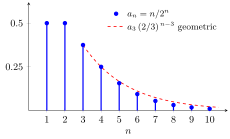
The figure shows an=n/2n. Here anan+1=2nn+1→L=21<1. For n≥3,an+1≤32an, so an≤a3(32)n−3: the dashed geometric curve lies above the terms from n=3 on, and ∑an converges by comparison.
Move x: the ratios ∣an+1/an∣ (right) settle at L=∣x−a∣/R. The series converges for L<1 and diverges for L>1.
The test only looks at the limit L, so the case L=1 gives no information: the Examples show that n∑1/n diverges and n∑1/n2 converges, and both have L=1. The test also says nothing when the limit does not exist; the root test then often still works, and whenever the ratio limit exists, the root test gives the same L.
Applied to a power series, the ratio of consecutive terms is cncn+1∣x−a∣, which tends to ∣x−a∣/R with R=limn→∞∣cn/cn+1∣. The series converges for ∣x−a∣<R and diverges for ∣x−a∣>R, which is how the Key Result finds the radius of convergence. Ratios are convenient for terms with factorials and powers, as in n∑xn/n!.
A common slip is to conclude convergence because every ratio is below 1. For the harmonic series, an+1/an=n/(n+1)<1 for every n, yet the series diverges: the ratios tend to 1, so they are not bounded by a fixed number below 1.
For the power seriesn=0∑∞cn(x−a)n with eventually nonzero coefficients, the radius of convergenceR can be found using R=n→∞limcn+1cn if the limit exists or tends to infinity.