Uniform Continuity
Definition
A function with is said to be uniformly continuous if, for every there exists a such that for all pairs of points with it holds that
The same controls all input pairs of the Function , rather than being selected separately for each point.
Interpretation
Uniform continuity means that one rule for "how close is close enough" works everywhere: for each there is a single that serves every pair of points of , wherever they lie. Ordinary continuity only asks for a at each point separately, and that may shrink from point to point.
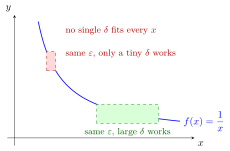
Both rectangles in the figure have the same height, so they correspond to the same . Near the graph of is flat enough for a wide rectangle; near the graph is so steep that only a very narrow one fits. At a point the largest that works for is , which tends to as , so no positive serves all points of .
For a fixed the right panel shows the largest admissible at each . Uniform continuity means one positive works everywhere; for the admissible shrinks to near .
In the definition both points and are free, and may depend on only. Uniform continuity is therefore a property of on the whole set , not at a single point: the same function is uniformly continuous on and not on , as in the Examples. A simple way to obtain it is a bound for all , as for ; then works.
On a closed bounded interval nothing extra is needed: by the Heine-Cantor theorem, every continuous function on is uniformly continuous.
A common slip is to say that is "uniformly continuous at ". The phrase has no meaning: uniformity is about all points of at once.
The definition returns later for functions between more general spaces, with a general distance in place of .
Key Results
- Every uniformly continuous function is continuous, the converse doesn't necessarily hold.
- is uniformly continuous on if and only if given two equivalent sequences and in (that is, as ), the sequences and are also equivalent.
- A continuous function is uniformly continuous on if and only if the right limit and the left limit both exist and are finite. In particular, a continuous function that is unbounded on a bounded interval is not uniformly continuous there; a bounded function can fail too, for example on , which has no right limit at .
- A differentiable function is uniformly continuous on if is bounded. Boundedness of is sufficient, not necessary: is uniformly continuous on although its derivative is unbounded there. A typical failure on an unbounded domain is on whose slope is unbounded.
Examples
- The function is uniformly continuous on , but not uniformly continuous on .
- The function is uniformly continuous on all of (hence on any interval), since
Prerequisites
Related Concepts
Sources
- Math III: Analysis · Lecture 1
Symbols: delta, element of, epsilon, infinity, real numbers, square root, subset
Last updated: 20 October 2026 03:02
Uniform ContinuityUniform Continuity between Metric SpacesFunctionContinuity