Radius and Interval of Convergence
Definition
For a given power series its radius of convergence is a nonnegative real number or such that the series converges if and diverges if The interval of convergence is the set of all values of for which the series converges.
Interpretation
The radius of convergence tells how far from the centre a power series converges. Apart from the boundary, only the distance matters: the series converges at every within distance of the centre and diverges at every further away.
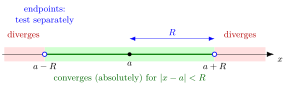
The figure shows the open interval where the series converges (absolutely), the radius as an arrow from the centre, and divergence outside. The endpoints are drawn as open circles because the radius says nothing about them. The interval of convergence is together with those endpoints at which the series converges. For and all four cases occur: converges on , on , on , and on .
Each series converges for and diverges for ; what happens at the endpoints differs from series to series.
Every power series has such an . The extreme cases are , where the series converges only at its centre, and , where it converges for every real . In practice is computed with the ratio test, when this limit exists, or with the root test, , which always applies.
Inside the radius, the series converges uniformly on every closed interval with , and its sum can be differentiated term by term, as shown in convergence of power series.
Two slips are common. The interval is centred at , not at : for in the Examples, and the interval is . And the endpoints must be tested separately, with tests for numerical series; their behaviour cannot be read from .
Key Results
- The convergence of at and is to be determined case-by-case.
Examples
- The series with centred at , converges pointwise on and uniformly on any closed interval within it. Its convergence interval is since the series diverges at both endpoints.
- The series with centred at , converges solely at its centre
Prerequisites
Related Concepts
Sources
- Math III: Analysis · Lecture 2
Aliases: radius of convergence, interval of convergence, convergence radius Symbols: element of, infinity, sum
Last updated: 20 October 2026 03:02
Radius and Interval of ConvergenceConvergence of Power SeriesPower SeriesRatio TestRoot Test