Disjoint Events
Definition
Let and be events. The events and are disjoint or mutually exclusive if
Interpretation
Disjoint events have no outcome in common, so they cannot happen on the same run of the experiment: once one of them occurs, the other is ruled out.
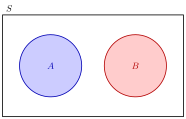
The two discs do not overlap, so their intersection is the empty set, and by the third axiom of probability their probabilities add: for a fair die, and are disjoint and .
Disjointness is a property of the events as sets, not of their probabilities. For more than two events it means pairwise disjoint: , and have no outcome common to all three, yet no two of them are disjoint.
A common slip is to read "disjoint" as "unrelated": knowing that occurred tells you that did not. This differs from independence, where knowing that one event occurred does not change the probability of the other.
Key Results
- Disjoint events have empty intersection.
- For disjoint events, .
- Disjoint events and are independent only if or , because must then equal .
Examples
- On one die roll, rolling a one and rolling a six are disjoint events.
- Drawing a red card and drawing a black card on a single draw are disjoint.
- Passing and failing the same exam attempt are mutually exclusive outcomes.
Prerequisites
Related Concepts
Sources
- Probability Theory for EOR · Week 1
Aliases: mutually exclusive events, incompatible events, pairwise disjoint events Symbols: intersection, union
Last updated: 20 October 2026 03:02
Disjoint EventsAxioms of ProbabilityPartition of a SetEventIntersection of SetsEmpty SetIndependent EventsInclusion-Exclusion PrincipleUnion and Intersection of EventsDisjoint Sets