Exogenous and Endogenous Variables
Definition
In an equation system , the variables in are called exogenous variables if they are treated as freely chosen inputs. The variables in are called endogenous variables if the equation system is used to solve for them as functions of .
When possible, the implicit function theorem gives a local function such that
Interpretation
Exogenous variables are the knobs set from outside the system. Endogenous variables are the quantities the system determines in response.
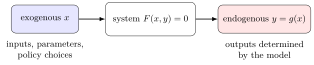
The model takes the exogenous variables as inputs and solves for the endogenous variables. Under the local invertibility assumptions of the implicit function theorem, equations determine endogenous variables locally once the inputs are fixed. The split is a modelling choice: prices are endogenous in an equilibrium model but exogenous for a price-taker.
The local function assigns endogenous outputs to exogenous inputs. The partial Jacobian with respect to the endogenous variables is the block whose invertibility lets the implicit function theorem solve for those outputs.
Key Results
- The distinction depends on how the equation system is being used, not only on the symbols.
- The implicit function theorem requires the partial Jacobian with respect to the endogenous variables to be invertible in the square case.
- Comparative statics studies how endogenous variables change when exogenous variables are perturbed, that is, the derivatives of the local function above.
Examples
- In , if is chosen externally, then is endogenous.
- In supply and demand equilibrium, a tax can be exogenous while price and quantity are endogenous equilibrium variables.
Prerequisites
Related Concepts
Sources
- Math IV: Multivariate Calculus · Week 2, Lecture 2
Keywords: exogenous variable, endogenous variable, free and determined variables
Last updated: 14 October 2026 08:21
Exogenous and Endogenous VariablesFunctionJacobian MatrixImplicit Function TheoremPartial JacobiansParametric Constrained Optimization Problem