Second-Order Partial Derivative
Definition
Let be a function and let be coordinate variables. A second-order partial derivative is obtained by differentiating a first-order partial derivative again:
When , this is called a mixed partial derivative or cross partial derivative.
Interpretation
A second-order partial derivative measures how one first-order rate of change changes as another input is varied. Mixed partial derivatives compare changes across two different coordinate directions.
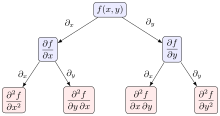
The expression means differentiating first with respect to and then with respect to . For a scalar-valued function, the ordered second partials form its Hessian. For a vector-valued function, each scalar component has its own Hessian. Pure partials measure curvature along an axis; mixed partials measure how a slope changes in another coordinate direction and agree in symmetric pairs when is .
The entries of are the second-order partial derivatives at ; drag the point to see them change.
Key Results
- If the relevant mixed partial derivatives are continuous near a point, then their order may be exchanged.
- Second-order partial derivatives form the entries of the Hessian matrix for scalar-valued functions.
- Second-order information is the basic input for local curvature and extrema tests.
Examples
- For , and .
- For , and .
Prerequisites
Related Concepts
Sources
- Math IV: Multivariate Calculus · Week 1, Lecture 1
Aliases: second partial derivative, second-order mixed derivative, mixed partial Keywords: mixed partial derivative, cross partial derivative Symbols: partial, real numbers, subset
Last updated: 17 October 2026 21:53
Second-Order Partial DerivativeHessian MatrixHigher-Order Partial DerivativeSymmetry of Second DerivativesPartial DerivativeTwice Continuous Differentiability on R^n