Complementary Slackness
Definition
For an inequality constraint written as (for example for a constraint ) with multiplier , complementary slackness is the condition
Equivalently, either the constraint is binding or its multiplier is zero.
Interpretation
Complementary slackness says that a constraint can matter through its multiplier only when it is actually tight.
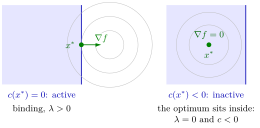
On the left, the binding constraint holds back the maximum, with , , and . On the right, the optimum lies in the interior and the multiplier is zero. The grey curves are objective level sets and the blue region is feasible.
Move and the peak: either the constraint binds, or its multiplier is , so the product is always .
The inequality fixes the sign of the slack. A strictly negative constraint value forces its multiplier to zero because their product must vanish; equality permits a nonzero multiplier.
Key Results
- If , then .
- If , then .
- The condition is part of the Kuhn-Tucker system for inequality-constrained optimization.
Examples
- If is written as and the optimum has , then the multiplier must be .
- If a multiplier for is positive, then the optimum must satisfy .
Prerequisites
Related Concepts
- Kuhn-Tucker Conditions with Nonnegativity Constraints
- Method of Lagrange for Inequality-Constrained Maximization
- Nonnegativity Constraint
- Slack Variable
Sources
- Math IV: Multivariate Calculus · Week 5, Lecture 1
Aliases: complementary slackness condition, kt slackness, complementarity condition Keywords: slackness condition Symbols: lambda, nabla gradient
Last updated: 17 October 2026 21:53
Complementary SlacknessBinding and Nonbinding ConstraintsLagrange MultiplierInequalityKuhn-Tucker Conditions with Nonnegativity ConstraintsMethod of Lagrange for Inequality-Constrained MaximizationNonnegativity ConstraintSlack Variable