Principal Minors and Sylvester's Criterion
Theorem
Let and let . The principal submatrix keeps the rows and columns indexed by , and its principal minor is . The -th leading principal submatrix is , and its determinant is the -th leading principal minor.
If is symmetric, Sylvester's criterion states:
- is positive definite if and only if for all .
- is negative definite if and only if for all .
- Positive and negative semidefinite cases require all principal minors with the corresponding sign pattern.
Interpretation
Principal minors are determinants of square submatrices that keep the same rows as columns, unlike general minors. Sylvester's criterion reads the definiteness of a symmetric matrix from the signs of its leading principal minors, usually quicker than computing eigenvalues.
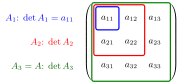
The nested boxes are the leading principal submatrices , and of a matrix: each is the top-left block, and . Positive definiteness requires the signs for their determinants, negative definiteness the alternating signs .
Change the symmetric matrix: positive leading minors give a positive definite form (one colour everywhere); a negative shows both colours.
If is positive definite, so is each : for with only its first entries nonzero, is the quadratic form of . A positive definite matrix has positive eigenvalues (definiteness and eigenvalues) and its determinant is their product, so every . For negative definiteness, apply this to and use : that is where the alternation comes from.
Symmetry matters: the non-symmetric matrix has leading minors and , yet at . For semidefiniteness the leading minors are not enough: has leading minors and , and only the principal minor from row and column shows that it is not positive semidefinite.
A common slip is to read "negative definite" as "all leading minors negative". For from the Examples the leading minors are and : the even-order ones are positive. The criterion is applied to Hessians, and in bordered form to constrained directions.
Key Results
- Leading principal minors are enough for positive and negative definiteness.
- Semidefinite cases require checking all principal minors.
- The criterion applies to symmetric matrices.
Examples
- For , the leading minors are and , so is positive definite.
- For , the alternating sign test shows negative definiteness.
Prerequisites
Related Concepts
Sources
- Math IV: Multivariate Calculus · Week 3, Lecture 2
Aliases: Sylvester criterion Keywords: principal minor, leading principal minor, Sylvester's criterion, principal submatrix Symbols: element of, real numbers, subset
Last updated: 20 October 2026 03:02
Principal Minors and Sylvester's CriterionBordered Matrix TestMatrixDefinite MatrixDeterminant