Affine Subspace
Definition
Let be a real vector space, a subspace and . The set
is an affine subspace of . The subspace is its direction space, and the dimension of the affine subspace is defined as . Some texts also count the empty set as affine; here an affine subspace is always nonempty.
Equivalently, a nonempty set is affine if and only if it contains every affine combination of its points: for all and all .
Interpretation
An affine subspace is a subspace shifted away from the origin: a point, a line, a plane or a higher-dimensional flat that need not pass through . It is "flat" because the whole line through any two of its points stays inside it.
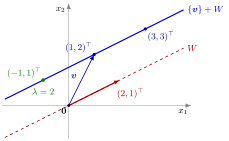
The figure draws the line from the second example. The dashed red line is the direction space through ; the blue line is with , the same line shifted off the origin. It contains and , and also the affine combination with , which lies outside the segment between them. Since is not on the blue line, is not a subspace.
The condition matters. Requiring only gives a convex set, so a line segment is convex but not affine.
The most common source of affine subspaces is linear systems. A consistent system of linear equations with has a solution set that is not a subspace (it misses ), yet it is one particular solution plus the kernel . Affine subspaces are exactly the nonempty level sets of affine maps.
Key Results
- The direction space is unique: . The base point is not unique: if and only if .
- An affine subspace is a linear subspace if and only if , that is, if and only if .
- If is consistent and is any solution, its solution set is , of dimension for an matrix .
- A nonempty intersection of affine subspaces is affine; the image of an affine subspace under a linear map is affine.
- In the affine subspaces of dimension are the hyperplanes with .
Examples
A plane in . The solution set of contains . The direction space is the null space of , spanned by and . Hence
an affine subspace of dimension . It is not a subspace, since .
A line in . The line through and is . The affine combination with , , is the point with parameter , so it lies on the line, as it must.
Non-examples. The union of two distinct lines through and the unit circle are not affine: in each case the line through two suitable points leaves the set.
Prerequisites
Related Concepts
Sources
- Math V: Advanced Linear Algebra · Week 5
Aliases: affine set, flat, linear manifold, translated subspace, linear variety, affine linear subspace, translate of a subspace Keywords: {v} + W, v + W, direction space, affine combination, solution set of Ax = b, particular solution plus null space Symbols: element of, lambda, real numbers, subset
Last updated: 22 October 2026 19:04
Affine SubspaceSubspaceKernelSystem of Linear EquationsAffine MapHyperplaneOrthogonal ProjectionLeast Squares