Difference Equation
Definition
A difference equation of order for a sequence is a relation
for , in which actually occurs; the order is the gap between the largest and the smallest time index. A solution is a sequence satisfying the relation for every .
The equation is linear if it has the form
with for all . It is homogeneous if for all , and has constant coefficients if no depends on . A constant solution is an equilibrium (steady state).
Interpretation
A difference equation is a rule that produces the next value of a quantity from the current and a few past values, as in a savings balance, a price, or a population observed once per period. Time is discrete; the continuous-time counterpart is a differential equation, studied from Week 3.
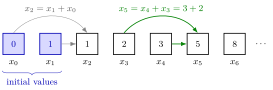
The figure runs the Fibonacci example . The two shaded initial values , are given; every later box is filled by the rule from the two boxes before it, so and, further on, . Because the equation has order , exactly two starting values are needed, and changing them produces a different solution.
The name comes from the forward difference : the equation is the same as . Any relation between and its differences can be rewritten with shifted terms.
The order counts how many consecutive past values the rule needs, not the largest index. In the smallest index is , so with it reads , an equation of order . For a homogeneous linear equation the solution set is a vector space (for an inhomogeneous one it is a shifted copy of that space, not a vector space), which is why linear algebra applies.
Key Results
- For an equation in the explicit form above, any choice of the initial values determines exactly one solution, computed recursively.
- The solutions of a homogeneous linear equation of order form a -dimensional subspace of the space of real sequences; see basis of solutions.
- For a linear equation, every solution equals one particular solution plus a solution of the homogeneous equation.
- An equilibrium of is a fixed point, .
- A linear equation of order can be rewritten as a first-order system in .
Examples
First order. with gives :
Fibonacci. is linear, homogeneous, of order with constant coefficients. With , the recursion gives ; other initial values give other solutions.
Nonlinear. The logistic map has order but is not linear. Its equilibria solve , so or (for ).
Prerequisites
Related Concepts
- First-Order Linear Difference Equation
- Second-Order Linear Difference Equation
- System of Linear Difference Equations
- Differential Equation
- Markov Chain
Sources
- Math V: Advanced Linear Algebra · Week 2
Aliases: recurrence relation, recurrence equation, discrete-time dynamical system, discrete dynamical system Keywords: x_{t+1}, order of a difference equation, linear difference equation, homogeneous difference equation, initial values, Fibonacci recurrence Symbols: delta, real numbers
Last updated: 22 October 2026 19:04
Difference EquationCharacteristic Polynomial for a Difference EquationFirst-Order Linear Difference EquationSecond-Order Linear Difference EquationSequenceVector SpaceSystem of Linear Difference EquationsDifferential EquationMarkov Chain