Linear Vector ODE
Definition
A linear vector ODE (ordinary differential equation) with constant coefficients is a system of differential equations of the form
where is the state vector, is its componentwise derivative , and is a constant matrix. The inhomogeneous form is . An initial value problem fixes .
Interpretation
The scalar equation has solution . The vector equation behaves the same way along each eigenvector: if (an eigenvalue and eigenvector pair), then is a solution, because . With an eigenbasis, every solution is a combination of such modes.
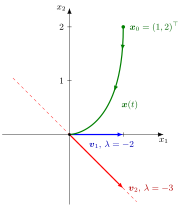
The figure uses the triangular example below, , with eigenvectors () and (). The solution from is . Both modes decay, so the curve runs into the origin; the -mode dies out faster, so the curve arrives along the slower direction .
Change the entries of and watch its eigenvalues against the shaded half-plane: while every eigenvalue has negative real part, all solutions tend to ; complex eigenvalues make the orbits spiral.
Each eigenvalue contributes the size factor and, if , a rotation with angular speed . Hence the real parts decide long-run behaviour. This is the continuous-time rule; for difference equations the rule is instead (see stability of a system of linear difference equations). Confusing the two is a common error.
The origin is always an equilibrium of ; stability is meant in the sense of stability of an equilibrium.
Key Results
- Existence and uniqueness: the initial value problem has the unique solution , with the matrix exponential.
- If is an eigenbasis with eigenvalues , then , with solving .
- A real matrix with eigenvalue , , and eigenvector (its conjugate is then also an eigenvalue, see complex conjugate pair of eigenvalues) gives the two real solutions and , found with Euler's formula.
- If is not diagonalizable, generalized eigenvectors and the Jordan normal form add terms .
- Stability (stable: all solutions bounded; asymptotically stable: all solutions converge): is asymptotically stable if and only if every eigenvalue of has negative real part; it is unstable if some eigenvalue has positive real part. If all real parts are , the origin is stable exactly when each eigenvalue with zero real part has equal algebraic and geometric multiplicity.
- If is invertible and is constant, and .
Examples
Triangular matrix. has eigenvalues with eigenvectors and . For : , , so , and
Check: . Both eigenvalues are negative, so .
Rotation. has eigenvalues . The solution circles the origin with constant length: stable, not asymptotically stable.
Saddle. has eigenvalues and ; the mode grows, so the origin is unstable although one eigenvalue is negative.
Prerequisites
Related Concepts
- Matrix Exponential
- General Solution of a Linear ODE
- Stability of a System of Linear Difference Equations
- Complex Conjugate Pair of Eigenvalues
- Jordan Normal Form
Sources
- Math V: Advanced Linear Algebra · Week 4
Aliases: linear system of ODEs, linear vector differential equation, linear system of differential equations Keywords: x'(t)=Ax(t), e^{lambda t} v, eigenvalue solution, asymptotic stability of x' = Ax, negative real part Symbols: alpha, beta, element of, lambda, real numbers, sum
Last updated: 17 October 2026 21:53
Linear Vector ODESystem of Differential EquationsStability of an EquilibriumEigenvalue and EigenvectorEigenbasisMatrix ExponentialGeneral Solution of a Linear ODEStability of a System of Linear Difference EquationsComplex Conjugate Pair of EigenvaluesJordan Normal Form