Higher-Order Linear Difference Equation
Definition
A linear difference equation of order with constant coefficients is
for , with real constants , , and a given sequence . With the state vector it is equivalent to the first-order system
where is the companion matrix and the last standard basis vector.
Interpretation
The second-order equation generalizes directly: the next value uses the most recent values, so initial values are needed. The homogeneous equation is solved by the roots of the characteristic polynomial , now of degree , so for the roots may be harder to find and a factor is often guessed first (with integer coefficients, every integer root divides ).
The companion form shows why difference equations belong to linear algebra. The first rows of only shift the window forward one period; the last row is the equation itself. Iterating is repeated matrix multiplication, in the homogeneous case, and , so the characteristic roots are the eigenvalues of .
A common slip is to write the last row of with instead of : the signs flip because is isolated on the left.
Key Results
- Every choice of gives exactly one solution; the homogeneous solutions form a -dimensional space with a basis of solutions built from the characteristic roots.
- A root of multiplicity contributes .
- General solution = particular solution + general homogeneous solution; for and the equilibrium is a particular solution.
- , so is invertible.
- All solutions converge to if and only if every characteristic root has modulus less than (stability).
Examples
Third order, distinct roots. has , so . For , , :
giving , , and . Check: . The companion matrix is , with eigenvalues .
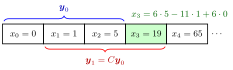
The state is a window of three consecutive values. In the figure, is bracketed above the row and below it: the first two rows of copy and one place forward, and the last row produces the new value . Repeating the step gives .
Triple root. has , so : exactly the sequences whose third differences vanish.
Prerequisites
- Second-Order Linear Difference Equation
- Characteristic Polynomial for a Difference Equation
- Matrix Product
Related Concepts
- System of Linear Difference Equations
- Basis of Solutions of a Difference Equation
- Stability of a Scalar Difference Equation
- Stability of Solutions of Higher-Order ODEs
Sources
- Math V: Advanced Linear Algebra · Week 2
Aliases: Higher Order Linear Difference Equation, kth-order linear difference equation, linear recurrence of order k, linear difference equation of order k, nth-order linear difference equation Keywords: companion matrix, state vector (x_t, x_{t+1}, ..., x_{t+k-1}), k initial values, reduction to a first-order system Symbols: element of, lambda, real numbers
Last updated: 22 October 2026 19:04
Higher-Order Linear Difference EquationSecond-Order Linear Difference EquationCharacteristic Polynomial for a Difference EquationMatrix ProductSystem of Linear Difference EquationsBasis of Solutions of a Difference EquationStability of a Scalar Difference EquationStability of Solutions of Higher-Order ODEs