Basis of Solutions of a Difference Equation
Definition
Consider the homogeneous linear difference equation of order with constant coefficients and ,
Its solutions form a subspace of the vector space of real sequences. A basis of solutions (fundamental set) is a list of solutions that is a basis of : the sequences are linearly independent, and every solution can be written uniquely as
This expression with arbitrary constants is the general solution.
Interpretation
Linearity makes sums and scalar multiples of solutions again solutions, so the solution set is a vector space. Its dimension is because a solution is fixed by its initial values: the map is a linear bijection from onto . A basis therefore gives coordinates for every possible trajectory, and fitting initial values means solving a linear system.
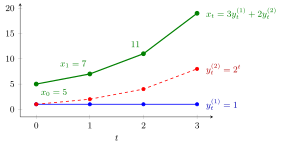
The figure uses the first example, . Its basis solutions are the constant sequence and . The initial values , fix the coordinates , , and the green trajectory follows: . Other initial values give other coordinates for the same two basis sequences.
Change and : every solution of is a combination of the two basis solutions, and the two initial values fix the coefficients uniquely.
The standard basis comes from the characteristic polynomial. A common error is to take fewer than sequences, for example only for a double root ; the list then spans a proper subspace and cannot match all initial values. Another is to take sequences that are multiples of each other, such as and , which are dependent.
The inhomogeneous equation has no basis of solutions: its solution set is the affine subspace "particular solution ".
Key Results
- ; any linearly independent solutions form a basis.
- solutions form a basis if and only if their vectors of initial values , , are linearly independent, that is, the matrix with these vectors as columns has nonzero determinant.
- If the roots are distinct, is a basis (the matrix of initial values is a Vandermonde matrix).
- A root of multiplicity contributes ; a nonreal pair may be replaced by .
Examples
Fitting initial values. For the roots are and , so , , and the matrix of initial values has . For , : , , so , and . Check: .
Repeated root. For take and . Their matrix of initial values has , so they form a basis.
Not a basis. and both solve the previous equation, but : they are dependent and cannot produce the solution with , .
Prerequisites
- Characteristic Polynomial for a Difference Equation
- Linear Dependence and Independence
- Basis
- Determinant
Related Concepts
- Higher-Order Linear Difference Equation
- Second-Order Linear Difference Equation
- System of Linear Difference Equations
- General Solution of a Linear ODE
Sources
- Math V: Advanced Linear Algebra · Week 2
Aliases: fundamental set of solutions, fundamental system of solutions, solution basis of a recurrence Keywords: dimension of the solution space is k, general solution c_1 r_1^t + ... + c_k r_k^t Symbols: real numbers, rho, theta
Last updated: 14 October 2026 08:21
Basis of Solutions of a Difference EquationCharacteristic Polynomial for a Difference EquationLinear Dependence and IndependenceBasisDeterminantHigher-Order Linear Difference EquationSecond-Order Linear Difference EquationSystem of Linear Difference EquationsGeneral Solution of a Linear ODE