Each step removes from aj its orthogonal projection onto the span of the earlier vectors; what is left, vj, is the component of aj in the orthogonal complement of that span. Dividing by the norm ∥vj∥=vj⋅vj (the Euclidean norm in Rn) then gives a unit vector. Since the qi are already orthonormal, the update can equally be written vj=aj−i<j∑(aj⋅qi)qi.
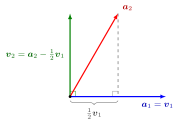
The figure shows the second step of the example below, drawn in the plane spanned by a1=(1,1,0)⊤ and a2=(1,0,1)⊤ with true lengths. The projection of a2 onto v1=a1 is 21v1, since (a2⋅v1)/(v1⋅v1)=21. Removing it leaves v2=a2−21v1=(21,−21,1)⊤, the dashed perpendicular moved to the origin, which is orthogonal to v1.
Step through j=1,2,3: each vj is aj minus its projections onto the earlier vi, so it is perpendicular to all of them. Edit an aj to make the vectors dependent and watch vj shrink to 0.
Linear independence is what guarantees vj=0, so that the division is allowed. The output depends on the order of the input: reordering the aj generally gives a different orthonormal basis of the same space.
A frequent slip is to project onto the original ai instead of the new vi; the ai are not orthogonal, so their projections overlap and the result is wrong.
vj=0 occurs exactly when aj∈span{a1,…,aj−1}; run on any list, the algorithm detects dependence, and discarding such aj yields an orthonormal basis of the span of the list.
Every finite-dimensional inner product space has an orthonormal basis, and every orthonormal list extends to one.
In floating-point arithmetic the classical version loses orthogonality; the modified version, which subtracts projections one at a time from the updated vector, is the numerically preferred form.
Beyond the course
Many textbooks collect the Gram-Schmidt output in a factorization A=QR of a matrix with independent columns, with Q having orthonormal columns and Rupper triangular. This QR decomposition is not part of Math V.