Equilibrium of a Differential Equation
Definition
Consider the autonomous first-order differential equation
where and is a given real function. A number is an equilibrium (steady state) if . Equivalently, the constant function is a solution.
For a vector equation with , an equilibrium is a vector with .
Interpretation
At an equilibrium the rate of change is zero, so a system that starts there stays there for ever. Finding equilibria is an algebraic task: they are the zeros of ; no differential equation needs to be solved.
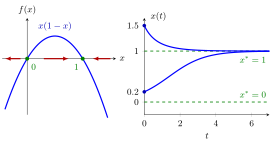
The figure shows the logistic example . On the left, the equilibria are the zeros and of , and the arrows on the axis form the phase line: to the right where , to the left where . On the right, the equilibria appear as constant solutions (dashed). The solution from rises towards , and a solution from falls towards ; neither crosses an equilibrium line.
Choose and drag : the equilibria are the zeros of and appear as constant solutions on the right, and the sign of between them decides whether rises or falls. For there is no equilibrium at all.
The sign of between consecutive equilibria shows the direction of motion: where solutions increase, where they decrease. This one-dimensional picture is called the phase line. Whether nearby solutions approach the equilibrium is a separate question, treated in stability of an equilibrium.
Two misunderstandings occur often. An equilibrium is a value of the state , not a time . And an equilibrium need not be reached: in the solution approaches but never equals it when . For a non-autonomous equation , a constant is a solution only if for every .
Key Results
- Equilibria of are exactly the constant solutions.
- For with there is a unique equilibrium , and every solution satisfies .
- For with : every point is an equilibrium if ; there is none if .
- If is continuously differentiable, solutions cannot cross or touch an equilibrium (uniqueness of solutions), so a solution starting between two equilibria stays between them and is monotone.
- For with invertible, the unique equilibrium is , using the inverse matrix.
Examples
Linear. : gives . The solution with is .
Logistic equation. has equilibria and . Since on , a solution with increases and stays in ; it tends to . For , and solutions decrease towards .
No equilibrium. has for every , so there is no equilibrium and every solution is strictly increasing.
Vector case. For and , solve : the second row gives , so ; the first row gives , so . Thus .
Prerequisites
Related Concepts
- Stability of an Equilibrium
- Linear Vector ODE
- Particular Solution of an Inhomogeneous Linear ODE
- Stability of a Scalar Difference Equation
Sources
- Math V: Advanced Linear Algebra · Week 3
Aliases: equilibrium point, steady state, rest point, equilibrium solution, equilibrium state Keywords: constant solution, f(x)=0, x=-b/a, autonomous equation, phase line, logistic equation Symbols: element of, real numbers
Last updated: 17 October 2026 21:53
Equilibrium of a Differential EquationStability of an EquilibriumFirst-Order Differential EquationZero of a FunctionConstant FunctionLinear Vector ODEParticular Solution of an Inhomogeneous Linear ODEStability of a Scalar Difference Equation