First-Order Differential Equation
Definition
A first-order differential equation is a differential equation in which only the unknown function and its first derivative occur. In explicit form,
for a given function of two variables. Three standard classes:
- linear: , with given functions of ; with constant coefficients this is ;
- autonomous: , where the right-hand side does not depend on ;
- separable: .
An initial value problem adds one condition .
Interpretation
The equation prescribes the slope of the solution curve at every point . Starting from at time , the solution follows these slopes; one initial value is enough because the equation has order 1.
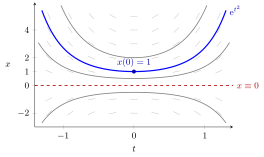
The figure draws the separable example . Each grey segment has the slope prescribed at its point; it depends on both and , flat on the line and steeper further out. The blue curve is the solution fixed by the single initial value . The grey curves are other solutions (here , , ). The dashed line is the constant solution , which division by loses.
Move to pick one curve from the family of . Then change and . For every solution approaches the equilibrium ; for solutions move away from it.
The constant-coefficient case is the continuous-time analogue of the first-order linear difference equation : the factor there becomes here. The sign of , not whether , decides growth or decay.
A frequent error is to drop the constant solutions of a separable equation. Dividing by is only allowed where ; each zero of gives the constant solution .
Key Results
- has general solution ; the initial value problem with has the unique solution . This uses the exponential function and .
- For , has general solution ; the constant is its equilibrium.
- If are continuous on an interval , the linear equation has a unique solution on all of for each ; it is found with an integrating factor.
- Separable equations are solved by wherever ; the chain rule justifies this step.
Examples
Continuous compounding. A balance with interest rate per year satisfies . With , , so .
Constant forcing. For with : here , , so and . Hence . Check: and . The solution tends to the equilibrium .
Separable. For with : for , gives , so . Check: . The function is the constant solution excluded by the division.
Prerequisites
Related Concepts
- Integrating Factor
- Equilibrium of a Differential Equation
- First-Order Linear Difference Equation
- System of Differential Equations
Sources
- Math V: Advanced Linear Algebra · Week 3
Aliases: First Order Differential Equation, first-order ODE, first order ODE Keywords: x'(t)=f(t,x(t)), x'=ax+b, linear first-order equation, separable equation, continuous compounding Symbols: integral
Last updated: 14 October 2026 08:21
First-Order Differential EquationEquilibrium of a Differential EquationIntegrating FactorSecond-Order Differential EquationSystem of Differential EquationsDifferential EquationExponential FunctionChain RuleFirst-Order Linear Difference Equation