Skip to content

Orthogonal Complement


Definition

Let VV be a real vector space with an inner product, written x⋅y\boldsymbol{x}\cdot\boldsymbol{y} (in Rn\mathbb{R}^n: the dot product), and let W⊆VW\subseteq V. The orthogonal complement of WW is

W⊥={v∈V ⁣:v⋅w=0for all w∈W},W^\perp=\{\boldsymbol{v}\in V\colon{}\boldsymbol{v}\cdot\boldsymbol{w}=0\quad \text{for all }\boldsymbol{w}\in W\},

the set of vectors orthogonal to every vector of WW. It is read "WW perp". Usually WW is a subspace.


Interpretation

W⊥W^\perp collects all directions perpendicular to WW. In R3\mathbb{R}^3 the complement of a plane through the origin is its normal line, and the complement of a line through the origin is the plane perpendicular to it.

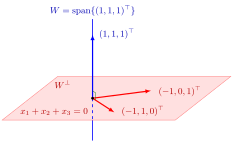
A line W through the origin of R^3 spanned by (1,1,1), and the plane W perp through the origin, x1 + x2 + x3 = 0, spanned by (-1,1,0) and (-1,0,1) and meeting W at a right angle.

The figure draws the first example below: W=span⁡{(1,1,1)⊤}W=\operatorname{span}\{(1,1,1)^{\top}\} is a line, and W⊥W^\perp is the plane x1+x2+x3=0x_1+x_2+x_3=0 with basis (−1,1,0)⊤,(−1,0,1)⊤(-1,1,0)^{\top},(-1,0,1)^{\top}. Every vector of the plane is orthogonal to (1,1,1)⊤(1,1,1)^{\top}, the two meet only in 0\boldsymbol{0}, and the dimensions add up to 1+2=31+2=3.

Switch between a line and a plane WW in R3\mathbb R^3: W⊥W^\perp is the plane or line through 0\boldsymbol{0} perpendicular to it, and dim⁡W+dim⁡W⊥=3\dim W+\dim W^\perp=3. Move b\boldsymbol{b} to see it split as p+e\boldsymbol{p}+\boldsymbol{e} with p∈W\boldsymbol{p}\in W and e∈W⊥\boldsymbol{e}\in W^\perp.

"Complement" does not mean set complement: V∖WV\setminus W is never a subspace, as it misses 0\boldsymbol{0}. Nor is W⊥W^\perp just some subspace UU with V=W⊕UV=W\oplus U: such complements are many, but the orthogonal one is unique. It depends on the inner product; with a different inner product on Rn\mathbb{R}^n the orthogonal complement can change.

To compute it, it suffices to test a spanning set: if W=span⁡{w1,…,wk}W=\operatorname{span}\{\boldsymbol{w}_1,\ldots,\boldsymbol{w}_k\}, then v∈W⊥\boldsymbol{v}\in W^\perp if and only if v⋅wi=0\boldsymbol{v}\cdot\boldsymbol{w}_i=0 for i=1,…,ki=1,\ldots,k. In Rn\mathbb{R}^n this is the homogeneous system M⊤v=0M^{\top}\boldsymbol{v}=\boldsymbol{0} with M=(w1⋯wk)M=\begin{pmatrix}\boldsymbol{w}_1&\cdots&\boldsymbol{w}_k\end{pmatrix}, so W⊥W^\perp is the null space (kernel) of M⊤M^{\top}.


Key Results

  • W⊥W^\perp is a subspace for every subset WW, and W⊥=(span⁡W)⊥W^\perp=(\operatorname{span}W)^\perp.
  • W∩W⊥={0}W\cap W^\perp=\{\boldsymbol{0}\} for a subspace WW, since w⋅w=0\boldsymbol{w}\cdot\boldsymbol{w}=0 forces w=0\boldsymbol{w}=\boldsymbol{0}.
  • If VV is finite-dimensional and WW a subspace: V=W⊕W⊥V=W\oplus W^\perp (a direct sum), dim⁡W+dim⁡W⊥=dim⁡V\dim W+\dim W^\perp=\dim V, and (W⊥)⊥=W(W^\perp)^\perp=W.
  • Inclusions reverse: W1⊆W2W_1\subseteq W_2 implies W2⊥⊆W1⊥W_2^\perp\subseteq W_1^\perp. Also (W1+W2)⊥=W1⊥∩W2⊥(W_1+W_2)^\perp=W_1^\perp\cap W_2^\perp.
  • {0}⊥=V\{\boldsymbol{0}\}^\perp=V and V⊥={0}V^\perp=\{\boldsymbol{0}\}.
  • For a real matrix AA, Null⁡(A)=Row⁡(A)⊥\operatorname{Null}(A)=\operatorname{Row}(A)^\perp and Null⁡(A⊤)=Col⁡(A)⊥\operatorname{Null}(A^{\top})=\operatorname{Col}(A)^\perp (Fundamental Theorem of Linear Algebra).

Examples

A line in R3\mathbb{R}^3. For W=span⁡{(1,1,1)⊤}W=\operatorname{span}\{(1,1,1)^{\top}\}, W⊥={x ⁣:x1+x2+x3=0}W^\perp=\{\boldsymbol{x}\colon x_1+x_2+x_3=0\}, with basis (−1,1,0)⊤,(−1,0,1)⊤(-1,1,0)^{\top},(-1,0,1)^{\top}. Dimensions: 1+2=31+2=3.

A plane in R3\mathbb{R}^3. For W={x ⁣:x1−2x2+x3=0}W=\{\boldsymbol{x}\colon x_1-2x_2+x_3=0\}, W⊥=span⁡{(1,−2,1)⊤}W^\perp=\operatorname{span}\{(1,-2,1)^{\top}\}: the coefficient vector is the normal vector of the plane.

A plane in R4\mathbb{R}^4. For W=span⁡{(1,0,1,0)⊤,(0,1,0,1)⊤}W=\operatorname{span}\{(1,0,1,0)^{\top},(0,1,0,1)^{\top}\}, the conditions x1+x3=0x_1+x_3=0 and x2+x4=0x_2+x_4=0 give

W⊥=span⁡{(10−10),(010−1)},W^\perp=\operatorname{span}\left\{\begin{pmatrix}1\\0\\-1\\0\end{pmatrix},\begin{pmatrix}0\\1\\0\\-1\end{pmatrix}\right\},

and 2+2=42+2=4. Note that (1,0,0,0)⊤(1,0,0,0)^{\top} is not in WW, yet it is not in W⊥W^\perp either: most vectors lie in neither.


Prerequisites


Sources

Aliases: perp, orthocomplement, perpendicular complement Keywords: W^⊥, W perp, (W^⊥)^⊥ = W, dim W + dim W^⊥ = n, R^n = W ⊕ W^⊥, normal line Symbols: element of, intersection, real numbers, subset

Last updated: 22 October 2026 19:04