Second-Order Linear Difference Equation
Definition
A second-order linear difference equation with constant coefficients is
for , with real constants and and a given sequence . Its homogeneous version has . Write for the roots of the characteristic polynomial . The general solution of the homogeneous equation is, with arbitrary constants :
- distinct real roots : ;
- a repeated root : ;
- nonreal roots with , : .
Interpretation
The next value depends on the two most recent values, so two initial values are needed to fix a solution; they determine . Unlike the first-order case, where the only oscillation is the sign alternation caused by , the solutions can oscillate with any frequency, because the roots may be nonreal complex numbers. The real form in the third case comes from combining the conjugate solutions and ; sets growth or decay and the frequency.
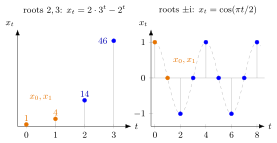
In both panels the two orange values are given, and every later value follows from the recursion. On the left, the distinct roots and of the first example below give , which grows like . On the right, the nonreal roots (, ) with , give , , so : an oscillation with frequency set by and constant amplitude .
Change and : the roots of fix the shape of , while the two initial values fix and . Make the roots coincide to see the repeated-root form .
The repeated-root case is a standard trap: is only a one-parameter family, so a second solution is needed.
For a constant input with , the constant is a particular solution, and the general solution is plus the homogeneous solution.
Key Results
- Every choice of gives exactly one solution; the homogeneous solutions form a two-dimensional space with the basis of solutions listed above.
- General solution of the inhomogeneous equation = one particular solution + general homogeneous solution.
- Root relations: and ; the roots are nonreal if and only if .
- If is a simple root of (so , ) and , there is no equilibrium; with is a particular solution.
- All solutions tend to if and only if and , equivalently and (see stability).
Examples
Distinct roots. , , . Then , so with , , giving , : . Check: .
Constant input. : , so and .
Complex roots. has with roots , so , and . With , : , period , neither growing nor decaying.
Prerequisites
Related Concepts
- Characteristic Polynomial for a Difference Equation
- Basis of Solutions of a Difference Equation
- Higher-Order Linear Difference Equation
- Second-Order Differential Equation
Sources
- Math V: Advanced Linear Algebra · Week 2
Aliases: Second Order Linear Difference Equation, second-order linear recurrence, linear second-order difference equation, linear difference equation of order two Keywords: x_{t+2} + a_1 x_{t+1} + a_0 x_t = g_t, two initial values, distinct, repeated and complex roots, r^t and t r^t, rho^t cos(theta t) Symbols: pi, rho, theta
Last updated: 17 October 2026 21:53
Second-Order Linear Difference EquationHigher-Order Linear Difference EquationDifference EquationFirst-Order Linear Difference EquationComplex NumberCharacteristic Polynomial for a Difference EquationBasis of Solutions of a Difference EquationSecond-Order Differential Equation