Tree
Definition
A tree is a connected undirected network containing no cycles. In the course, a tree can be formed by choosing a subset of the vertices and edges of a larger network.
Interpretation
A tree connects its vertices without any redundant edge: there is a route between every two vertices, and no cycle offers a second one. This makes it the basic structure for minimum-cost connection problems.
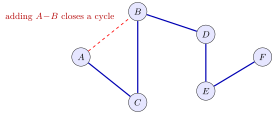
The five blue edges join all six vertices without a cycle, so they form a tree with edges. The dashed edge shows what one more edge does: and are already joined through , so it closes the cycle .
A tree sits exactly between two failures: removing any of its edges leaves it no longer connected, and adding any edge between two of its vertices creates a cycle. This is why the Kruskal method rejects every edge that would close a cycle when it builds a spanning tree.
Key Results
- A finite tree with vertices has edges.
- There is exactly one path between any two distinct vertices of a tree.
- A spanning tree additionally includes every vertex of the original network.
Examples
- The edges A-B and B-C form a tree on three vertices.
- A tree on 77 vertices has 76 edges, as reinforced by the final-week statements exercise.
Prerequisites
Related Concepts
Sources
- OR Modelling · Week 4
Last updated: 20 October 2026 03:02
TreeSpanning TreeExtensive-Form GameConnected NetworkCycleMinimum Spanning Tree