Cycle
Definition
In the course's network terminology, a cycle or tour is a path that starts and ends at the same vertex. Because its path convention requires distinct edges, no edge is repeated within such a cycle.
Interpretation
A cycle is a route that ends where it started. In the course's convention it is a path whose first and last vertices coincide, so no edge is used twice. Cycles describe routes that must return home, and they are excluded when constructing a tree.
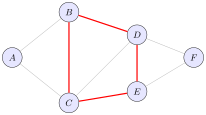
The red cycle uses the four edges , , and , each once, and returns to .
Only repeated edges are forbidden, so a cycle may pass through a vertex twice, like a figure of eight. Removing one edge of a cycle keeps the network connected, because the rest of the cycle still joins its two ends; this is why the Kruskal method rejects an edge that closes a cycle and a spanning tree contains none.
Key Results
- An Euler tour is a closed traversal using every edge exactly once.
- A tree contains no cycles.
- In the Chinese postman problem, “tour” is also used for a closed route that may repeat original edges; repeated copies are distinct in the augmented network.
Examples
The red cycle in the figure is . An undirected network with no cycles is a forest; when it is also connected, it is a tree.
- Three edges , , and form a cycle.
- Adding an edge between two already connected vertices of a tree creates a cycle.
Prerequisites
Related Concepts
Sources
- OR Modelling · Week 4
Aliases: closed path
Last updated: 20 October 2026 03:02
CycleEuler Tour AlgorithmEuler TourKruskal MethodTreePath in a NetworkChinese Postman Problem