Assignment Problem
Definition
The assignment problem pairs agents with tasks so that each agent receives exactly one task and each task exactly one agent. If is the cost of assigning agent to task , a binary model is
Interpretation
The assignment problem asks for the cheapest way to pair two equally large groups one-to-one, such as machines with jobs. The choices are coupled: once a task goes to one agent, it is no longer available for the others, so the pairs cannot be chosen one at a time.
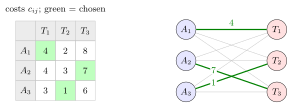
The table and the diagram show the same instance. Each green cell of the table is a bold edge in the diagram, and each row and each column of the table contains exactly one green cell. Of the complete assignments, three cost : besides the highlighted one, also and . An optimal assignment need not be unique.
In the binary integer program, means that agent performs task . The equation gives agent exactly one task, and gives task exactly one agent. Together they describe a perfect matching between agents and tasks, and the objective adds the costs of the chosen pairs. The model is a transportation problem in which every supply and every demand equals .
Listing all assignments is hopeless beyond small sizes: there are of them, already for . The Hungarian algorithm exploits the one-per-row, one-per-column structure instead, and dummy entries and forbidden pairs adapt the model to unequal group sizes and excluded pairs.
Key Results
- Costs can represent execution times as well as monetary amounts.
- Unequal numbers of agents and tasks can be handled with dummy entries.
- Task quotas can be modelled by duplicating agent rows into separate slots.
Examples
The illustrated three-agent instance has complete assignments. The highlighted pairs have total cost , which is optimal. For this assignment formulation with integer data, an integral optimal solution exists even after relaxing the binary restrictions.
- The main example assigns machines 1, 2, 3, 4 to jobs 1, 4, 2, 3, with cost 20.
- Machines can be assigned to locations or players to field positions.
Prerequisites
Related Concepts
Sources
- OR Modelling · Week 5
Aliases: linear assignment problem, linear sum assignment problem Symbols: element of, sum
Last updated: 22 October 2026 19:04
Assignment ProblemAssignment Cost TransformationDummy AssignmentForbidden AssignmentHungarian AlgorithmBinary Integer ProgramBipartite MatchingTask Quota Assignment