Discrete Newsvendor Rule
Proposition
Let demand be a nonnegative integer-valued random variable with CDF , finite mean, and newsvendor underage cost and overage cost . Over nonnegative integer order quantities, a smallest optimal quantity is
For the expected cost of ordering , the marginal difference is
Interpretation
With demand in whole units, the order is raised one unit at a time. Going from to changes the expected cost by , which is negative exactly when . So keep adding units while , and stop at the first with , where is the critical ratio.
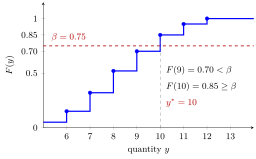
The CDF of integer demand is a staircase that jumps at the possible demand values. The level lies between and . Going from to still lowers the expected cost, because , while going from to raises it, because ; hence .
With integer demand, increase while : the first with is optimal.
The difference formula compares the two outcomes for unit . It is left over when , with probability and cost , and it is sold when , with probability and saving . Because never decreases, the differences never decrease either, so the first stop is a global optimum and not only a local one. If exactly, the step from to costs nothing and both quantities are optimal; the rule returns the smaller one. Usually no integer has , which is why the rule uses instead of solving an equation as the continuous rule does.
A common slip is to stop at the last with , here . That quantity still gains from one more unit.
Key Results
- If , quantities and have equal expected cost.
- All integer optimal quantities satisfy , taking .
- Compute the expected cost with the actual discrete probabilities, not only the critical ratio.
Examples
The drawn CDF steps other than and are schematic; they do not specify additional probabilities for the dress example.
- For the newspaper distribution, , so the smallest optimum is 17; expected cost is 1.975.
- The dress example has , optimal quantity 10, and expected cost 138.
Prerequisites
Related Concepts
Sources
- OR Modelling · Week 6
Symbols: beta, element of, integers
Last updated: 20 October 2026 03:02
Discrete Newsvendor RuleNewsvendor Price SensitivityCritical RatioPositive PartContinuous Newsvendor Rule