Underage Cost
Definition
The underage cost in the newsvendor model is the foregone margin on one unit of demand that cannot be served:
where is selling price and is unit cost. Expected underage cost is .
Interpretation
The underage cost is what one unit of unmet demand costs: the sale is lost, and with it the margin that the unit would have earned. It is the price of ordering one unit too few.
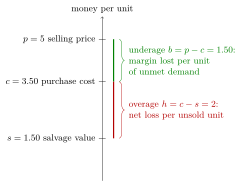
On the money scale for newspapers, the upper gap between the purchase cost and the selling price is ; the lower gap, down to the salvage value , is the overage cost . Here : running short is the cheaper mistake, and the critical ratio is below .
Each unit of unmet demand loses the margin . Raise and watch move up.
The loss is the margin, not the full price, because the purchase cost of a unit never bought is saved; using as the underage cost is a common slip. The positive part counts the units of unmet demand, and is charged once for each of them, unlike the EOQ shortage cost, which is charged per unit of waiting time.
Key Results
- Only demand above the available quantity contributes to underage loss.
- Increasing selling price increases underage cost when unit cost is fixed.
- The course assumes no additional per-unit stockout penalty beyond the lost margin.
Examples
The illustrated newspaper data give overage cost and underage cost , hence critical ratio . These are single-period per-unit losses, rather than EOQ cost rates.
- Newspapers sold for 5 and purchased for 3.50 have .
- Meals sold for 5.50 and costing 2.20 have .
Prerequisites
Related Concepts
Sources
- OR Modelling · Week 6
Aliases: understocking cost Symbols: beta
Last updated: 20 October 2026 03:02
Underage CostCritical RatioNewsvendor ModelPositive PartOverage CostShortage Cost