Shortage Cost
Definition
A shortage cost penalizes unmet demand. In the EOQ model with planned shortages, customers wait for replenishment and the parameter charges each outstanding unit per unit of waiting time. With batch size and stock on hand just after each delivery, so that the maximum backlog is , the average shortage cost rate is
Interpretation
A shortage cost puts a price on making customers wait. A planned backlog lets the shop keep less stock, but every waiting unit is charged per unit of time, so the model can trade holding cost against waiting customers.
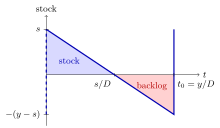
In one cycle of length , the stock falls from to zero at time and then becomes negative: the shaded triangle below the axis is the backlog, with depth and width , so its area adds up units times waiting time.
The cost rate is times this area divided by the cycle length. In the EOQ model with planned shortages the optimal backlog shrinks as grows. This is not the selling price of the newsvendor model, which charges a lost margin once per unit of unmet demand, not per unit of waiting time.
Key Results
- The red triangle has area . Multiplying by gives shortage cost per cycle; dividing by gives the cost rate .
- Demand is backordered and later filled: the arriving batch first clears the backlog and leaves units on hand.
- Use the same time unit for , , and .
- In the newsvendor notation, instead denotes selling price; symbols must be interpreted within their model.
Examples
- The phone shop compensates waiting customers by 6 per phone per day.
- The EOQ practice exercise permits planned shortages at 10 per unit per week.
Prerequisites
Related Concepts
Sources
- OR Modelling · Week 5
Aliases: stockout cost, backlog cost Keywords: backorder cost
Last updated: 27 October 2026 11:52
Shortage CostEOQ with Planned ShortagesInventory PolicyHolding CostUnderage Cost