Corner Point
Definition
In an LP with decision variables, a corner point is a point determined by the intersection of constraint boundaries with independent boundary equations. At least constraints are therefore active there, counting nonnegativity boundaries. A corner point is feasible only if it satisfies all constraints.
Interpretation
Corner points are the points where boundary lines of the constraints cross. In an LP with two variables, a corner is found by turning two constraints into equations and solving them together.
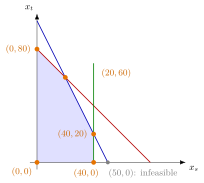
The orange points are the five feasible corners of the Giapetto region, from round to . The point , where the finishing line meets the axis , is also a corner point in the sense of the Definition, but it lies outside the region because violates the demand limit .
Every intersection of two boundaries is a candidate corner. Filled points are feasible corners; hollow ones lie outside the region.
With variables, a corner needs boundary equations that pin down exactly one point. In two variables these are two different lines that are not parallel: the lines and never meet, and writing the same line twice fixes no point. The five boundary lines of the figure, three constraints and two axes, form pairs; one pair is parallel, and of the other nine intersection points only five are feasible.
Corner points matter because an LP that has an optimum attains it at a feasible corner (corner point optimality). The graphical method uses this directly, and the simplex method later finds corners by algebra. A common slip is to treat every corner point as feasible: a corner satisfies its two defining constraints with equality, but the other constraints must still be checked.
Key Results
- In two dimensions, two nonparallel active boundaries determine a corner.
- Extra active constraints can occur at a degenerate corner.
- Not every intersection of boundaries is feasible.
Examples
The illustrated feasible corner solves and . The boundary intersection is infeasible because it violates the soldier-demand limit; it is not an extreme point of the feasible set. Feasible corners correspond to basic feasible solutions of the augmented model.
- The lines and intersect at .
- The nonnegativity boundaries meet at the origin .
Prerequisites
Related Concepts
Sources
- OR Modelling · Week 1
Aliases: extreme point, corner-point solution Keywords: vertex of the feasible region
Last updated: 20 October 2026 03:02
Corner PointCorner Point OptimalityConstraintFeasible RegionBasic SolutionDegeneracy