Simplex Pivot
Definition
A simplex pivot replaces the leaving basic variable with the entering variable. Divide the selected pivot row by the nonzero pivot element, then subtract appropriate multiples of that normalized row from every other row, including the objective row, so that the pivot column is a unit column.
Interpretation
A pivot is the algebra behind one step of the simplex method: one variable becomes basic, another becomes nonbasic, and the equations are rewritten so that the tableau is again in canonical form. The rewritten equations have exactly the same solutions as before; only their form changes.
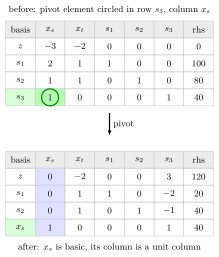
In the Giapetto example enters and leaves, so the pivot element is the in row , column . Afterwards the column is a unit column with its in the row now labelled . With the new tableau gives , , and : the solution has moved from the origin along an edge to the corner . The under shows that enters next.
Each pivot exchanges one basic variable for another; geometrically it moves to an adjacent corner of the feasible region.
Each row operation divides an equation by a nonzero number or adds a multiple of one equation to another. Both steps can be undone, so no solution is gained or lost; the objective row is treated like any other equation. The pivot row must be the one chosen by the minimum-ratio test, because that keeps every right-hand side nonnegative. Pivoting on the row of instead, with ratio , would set and give , an infeasible point.
The same elimination steps return in Linear Algebra as Gauss-Jordan elimination.
Key Results
- The pivot element is the intersection of the entering column and leaving row.
- Update all coefficients and the right-hand side during each row operation.
- Update the basic-variable label as well as the numerical entries.
Examples
In the illustrated Giapetto pivot, the row operations are
The new point is with ; the next entering variable is .
- Take the objective row with the constraints of the augmented-form example. Then enters and the minimum-ratio test picks the row of , so divide the pivot row by 2.
- Add three times that normalized row to to eliminate from the objective row.
Prerequisites
- Minimum-Ratio Test
- Simplex Tableau
- Gauss-Jordan row operations
Related Concepts
Sources
- OR Modelling · Week 2
Aliases: pivot operation, basis exchange
Last updated: 20 October 2026 03:02
Simplex PivotDegeneracyMinimum-Ratio TestSimplex TableauSimplex Method