Objective Line
Definition
For a two-variable linear objective with at least one nonzero coefficient, an objective line is the set of points giving a fixed value . If , its slope-intercept form is
Interpretation
An objective line collects all points with the same objective value. Changing the value moves the line parallel to itself without changing its slope, and this is what the graphical method uses: it slides the line as far as the feasible region allows.
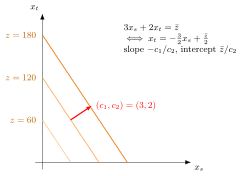
The three lines belong to with values , and . Each has slope , and raising by raises the intercept on the -axis by , from to to . The arrow shows the direction in which increases.
Change to translate the line and to turn it: all lines for one objective are parallel, with slope .
The slope-intercept form in the Definition shows the role of each number. The slope depends only on the coefficients, so all objective lines of one objective are parallel; the value enters only through the intercept . Moving a point by with changes by , so the direction always improves a maximization, and the opposite direction a minimization.
A common slip is to assume that a larger always moves the line upwards. That holds when ; for the intercept is , so the line moves down as grows. In economics the same lines are called isoprofit or isocost lines.
Key Results
- All constant-objective lines for a fixed objective are parallel.
- If , a larger objective value lowers the vertical intercept.
- When , the objective lines are vertical.
Examples
Translating a line in the direction raises its objective value. When a finite maximum is attained, the last objective line meeting the feasible region identifies it.
- gives .
- gives .
Prerequisites
- Objective Function
- Straight lines and slopes
Related Concepts
Sources
- OR Modelling · Week 1
Aliases: iso-profit line Keywords: Isoprofit line, Isocost line
Last updated: 20 October 2026 03:02
Objective LineGraphical MethodObjective FunctionMultiple Optimal Solutions