Two-Phase Method
Definition
The two-phase method initializes and solves an LP using artificial variables . Phase I maximizes
subject to the augmented constraints. If its optimum is negative, the original LP is infeasible. If its optimum is zero, restore the original objective, remove artificial variables from the working model, put the objective row in canonical form for the resulting feasible basis, and apply simplex in Phase II.
Interpretation
The two-phase method splits a difficult start into two easier problems. Phase I only asks whether the constraints can be satisfied at all and, if so, finds a basic feasible solution; Phase II then runs the ordinary simplex method from there with the real objective.
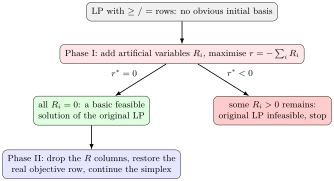
The flowchart starts from an LP with or rows, where no slack basis is available. Phase I adds artificial variables and maximizes . If , all are zero, so the solution satisfies the original constraints and Phase II continues from it. If , every feasible solution of the Phase I problem has some , so the original LP is infeasible.
The Phase I objective is chosen so that its optimum answers the feasibility question: since every , always , and exactly when all artificial variables vanish. The artificial variables only make a start possible: each has a unit column and starts at the right-hand side of its row, and a solution with some means nothing for the real problem.
Phase I ignores the real objective, so its solution need not be optimal: in the Examples it reaches , where , and Phase II improves this to at . Before Phase II, the real objective row must be restored and put in canonical form for the new basis; only then can the optimality test be read from it.
Key Results
- Eliminate basic artificial variables from the initial Phase I objective row before pivoting.
- The phase-I objective can never exceed zero.
- A zero-valued artificial variable still in the basis needs basis cleanup before its column is removed; the supplied worked example avoids this case.
Examples
- For and , Phase I finds .
- Phase II for objective reaches and value 25.
Prerequisites
Related Concepts
Sources
- OR Modelling · Week 2
Aliases: two-phase simplex method, two-phase simplex Symbols: sum
Last updated: 20 October 2026 03:02
Two-Phase MethodInfeasible Linear ProgramArtificial VariableSimplex MethodSimplex Tableau