Model Parameter
Definition
A model parameter is a given numerical input to the optimization model. In the course's LP notation, parameters include objective coefficients , constraint coefficients , and right-hand sides .
Interpretation
Parameters describe the circumstances under which decisions are made. A parameter may be an estimate even though the optimization treats its supplied value as fixed.
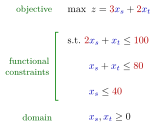
The objective function is the quantity to maximize (for example, profit) or minimize (for example, cost). Functional constraints describe what an allowed decision must satisfy, such as resource limits or demand requirements. Domain restrictions specify signs or integrality.
In the diagram, blue identifies decision variables, whose values the model determines; red identifies model parameters, the given data , and . In general, the model is subject to , where the constraints define the feasible set . A solution assigns values to all variables.
Key Results
- Changing parameters can change both the optimal decision and the optimal value.
- Units must agree within an equation or inequality.
- Sensitivity analysis investigates the effect of parameter changes.
Examples
- The coefficient in is profit per soldier.
- The right-hand side in is available finishing time.
Prerequisites
Related Concepts
Sources
- OR Modelling · Week 1
Aliases: input parameter Symbols: element of
Last updated: 17 October 2026 21:53
Model ParameterLinear Program FormulationSensitivity AnalysisObjective FunctionConstraintShadow Price in Linear Programming