Surplus Variable
Definition
A surplus variable transforms a lower-bound constraint into an equality:
It measures the excess of the left-hand side over the required minimum.
Interpretation
A surplus variable measures by how much a minimum requirement is exceeded: the amount achieved minus the required . Subtracting it turns a constraint into an equation, just as an added slack does for a constraint.
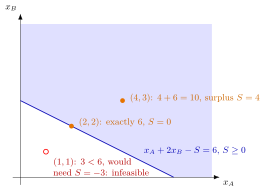
The figure shows written as . The point gives , so ; the point lies on the line with ; the point gives only and would need , which the sign restriction forbids, so it is infeasible.
The minus sign follows from what is measured, and the nonnegativity constraint carries the original direction; writing by mistake gives the opposite requirement . Unlike a slack, a surplus cannot start the simplex method, since at the origin it would be ; such rows therefore also receive an artificial variable.
Key Results
- The course uses capital for surplus and lower-case for slack.
- A surplus variable alone generally does not produce an initial feasible slack-style basis.
- An artificial variable may be added for the first simplex phase.
Examples
- becomes .
- At , this surplus is 2.
Prerequisites
Related Concepts
Sources
- OR Modelling · Week 2
Aliases: excess variable Symbols: sum
Last updated: 22 October 2026 19:04
Surplus VariableArtificial VariableConstraintNonnegativity ConstraintSlack Variable